

Paid in Advance
On craft, opportunity, and a generation of artists handed the reward before they had built the practice
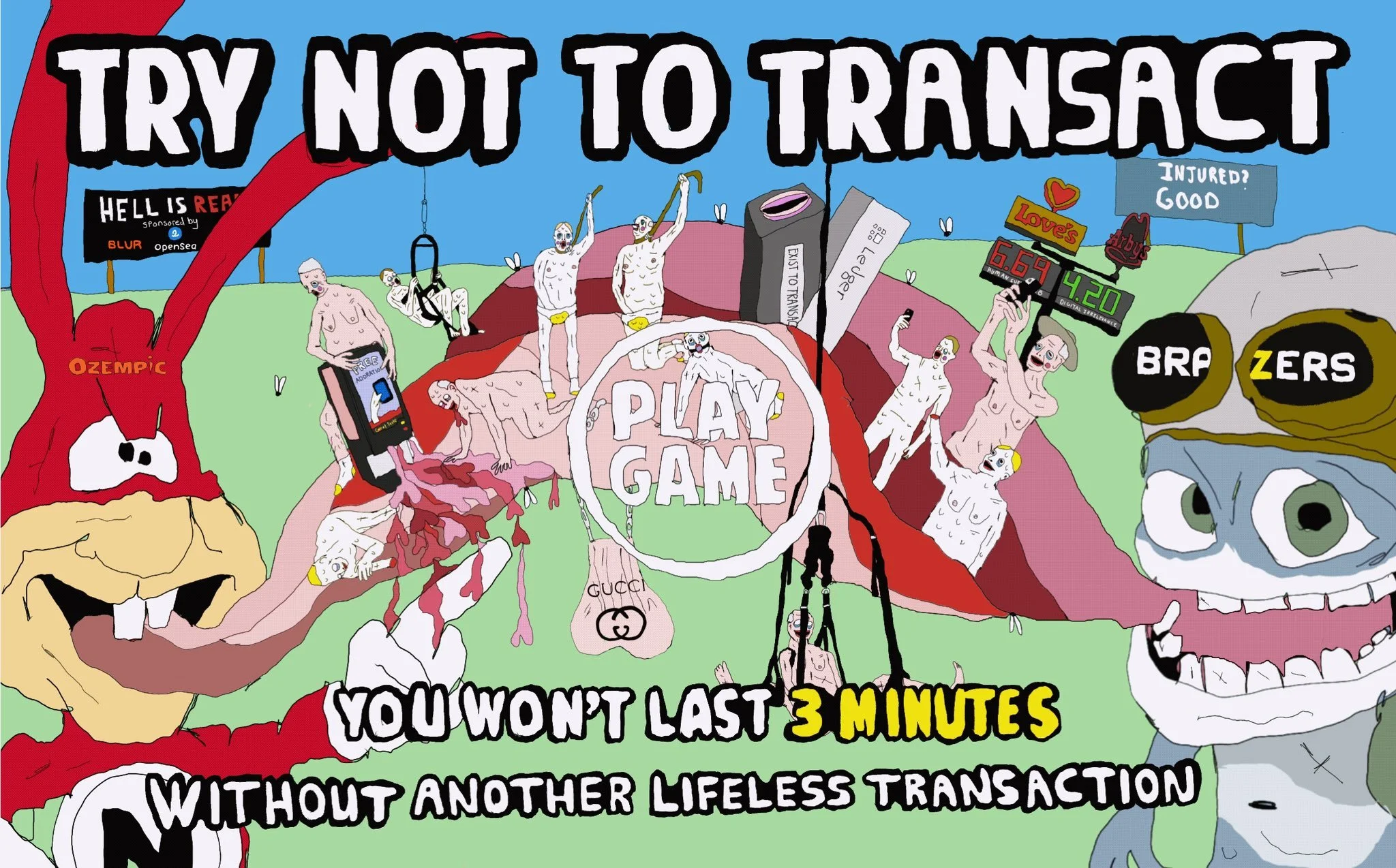
by diewiththemostlikes, Courtesy of the Artist.
A drawing by diewiththemostlikes, made in the plainest possible tools and making a point of it, arranges a landscape most of us could recognise blindfolded. A green field under a flat blue sky. Billboards along the horizon: HELL IS REAL, sponsored by Blur and OpenSea. INJURED? GOOD. A gas station price board quoting two commodities, human suffering at 6.69 and digital irrelevance at 4.20. Crazy Frog leers in from the right. What appears to be the Domino’s Noid leers in from the left, relabelled Ozempic. In the centre, heaped on a mound of pink flesh, a crowd of pale figures in harnesses and slings assume ADORATION. There’s a Gucci bag, a Ledger, an obelisk reading EXIST TO TRANSACT. Across the top: TRY NOT TO TRANSACT. Across the bottom: YOU WON’T LAST MINUTES WITHOUT ANOTHER LIFELESS TRANSACTION.
It is a Garden of Earthly Delights, and the citation is not accidental. The mound, the massing of small, nude bodies, the tripartite horizon, the objects scaled wrong agains the figures. Bosch’s central panel is conventionally read as a warning about pleasure. This one is a warning about liquidity, which is a harder thing to draw, as it has no face and it produces no visible ecstasy. The bodies here are not enjoying anything. They are executing. The composition is quietly accomplished; the surface refuses to be. That refusal is the arguent, and I want to come back to it.
I should say at the outset that the artist is not a symptom of what follows. He got the diagnosis before most of us did, and the essay below is an attempt to catch up to a picture.
First, the thing the picture is about.
The gap is not where we keep looking for it
The complaint is familiar enough to have gone stale. There are extraordinary artists in this space who cannot sell a single piece, and there are artists of unremarkable ability sitting on seven figures and a waiting list. From this we usually conclude that the market is broken, that talent is undervalued, that opportunity is unfairly distributed. All of which is true and none of which is interesting, because every art market in history has been unfair in roughly this way.
The more precise diagnosis is that there is no gap between craft and opportunity, because there is no bridge between them either. A gap implies two banks and a missing span. What we have is a field in which craft simply does not convert into anything the market can see.
Attention converts. Proximity converts. Being early converts. Craft is a private virtue here, pursued at a personal cost, with no exchange rate posted anywhere.
Bourdieu, and the exchange rates nobody set
Pierre Bourdieu’s contribution, in The Forms of Capital and then more fully in The Field of Cultural Production, was to insist that money is only one of several currencies in circulation, and rarely the decisive one.
He identified four:
Cultural capital: competence, reference, formation. It exists in three states: embodied in a person, objectified in the things they own, and institutionalised in credentials the field has agreed to honour. The embodied kind takes years, and cannot be bought or gifted.
Social Capital: the network, the room, the who-vouches-for-you
Symbolic Capital: the recognition that legitimates the others while concealing where they came from.
Two things about this system matter for us.
The first is that the currencies convert, but at a wildly different speeds and with heavy friction. Economic capital converts into almost anything, quickly. Embodied cultural capital is the slowest of all: it must be accumulated in person, over time, by the person themselves, and Bourdieu is explicit that it cannot be transmitted instantaneously by purchase or bequest. A collection can be bought in an afternoon. An eye cannot.
The second is Bourdieu’s description of the artistic field as l’économie renversée, the economic world reversed. In the autonomous pole of a functioning art field, legitimacy accrues to those who visibly do not chase money. Disinterestedness is not a personality trait there, it is a technology for producing symbolic capital, and symbolic capital is what eventually converts back into economic capital at a far better rate and with a much longer maturity. The gallery that turns down the sale, the artist who withdraws the work, the critic who declines the commission: whatever the people involved believe about their own motives, these are investments in a currency the field agreed to honour.
Web3 did not build an autonomous pole, it built the heteronomous pole and then nothing else. There is no subfield here in which not selling produces status. Price is the sole legible signal of value, floor price is quoted the way a museum quotes a wall label, and the flex is the number. When symbolic and economic capital collapse into a single variable, the field loses the only mechanism it had for producing legitimacy independent of the market. The reversal Bourdieu described never took place here, and nothing was built to stand in for it.
This is why craft cannot convert. Craft is a form of embodied cultural capital and cultural capital, through consecration: the show, the review, the acquisition, the argument in print. Strip out the consecrating institutions and, whatever the liberation rhetoric claimed at the time, what has actually been removed is the machine that turned years of work into standing. What remains is a market that can price a JPEG and cannot recognise a practice.
A room full of Five-year-olds
Here is the part that I think we have been too polite to say plainly.
The artists who surfaced in 2021 are, in the main, in their professional infancy, and so is the market that surfaced them. The point concerns sequence rather than ability, and it applies to both.
The normal formation of an artist runs on a specific order of operations, and the order is doing real work. You accumulate cultural capital first, for years, unpaid: technique, failure, reference, the slow acquisition of a position to argue from. Consecration comes late and comes from somewhere outside yourself. Economic capital comes last, if it comes, and by the time it arrives, the practice has a shape solid enough to survive it. I am not romanticising the lean years. They are, however, load-bearing, because they are when the thing that money will later be paid for is actually constructed.
In 2021, the order inverted. Economic capital arrived first, at scale, to people who, in many cases, had not yet built a practice for it to attach to. Twenty-six years old, six figures for a fourth edition, from an audience with no critics, historians or memory. There was no institution demanding formation… BECAUSE THERE WERE NO INSTITUTIONS. There were Discord servers and a handful of platforms with take rates.
What happens to a practice that is rewarded before it is formed is not mysterious. It organises itself around the reward. Not out of cynicism, mostly, but out of the ordinary human tendency to repeat what worked. The drop cadence becomes the studio schedule. The pricing strategy becomes the medium. The Twitter thread explaining the work does more labour than the work. Within eighteen months a generation of artists had acquired sophisticated instincts about liquidity, allocation and secondary volume, and comparatively little else, because nothing in the environment was asking for anything else.
They behaved the way unsupervised people behave. There were no adults in the room because the room was three years old. The market that was meant to teach them what mattered was itself learning on the job, and what it had learned by 2022 it learned from trading, because trading was the only thing anyone in it had done at volume.
The crassness that followed, and it was crass, was the predictable output of a field where the only available signal of worth was a number, and where every participant was young enough in the practice to mistake the signal for the thing. Assigning it to individual character misses where it came from.
Arendt, and what liquidity does to an object
Hannah Arendt draws a distinction in The Human Condition that has only grown more useful over the last five years. Labour produces things that are consumed almost as fast as they are made and leave nothing behind. Work produces durable objects, and it is these objects, accumulating, that constitute a shared world capable of outlasting the people in it. Artworks, for Arendt, are the most worldly things we make. Their entire function is durability. In The Crisis in Culture she goes further: cultural objects are those deliberately removed from consumption and use, and the moment a society begins consuming them as entertainment, it destroys them, however sincerely it claims to love them.
Arendt reserves a particular contempt for the philistine, who is not the person indifferent to culture but the person who values it instrumentally, as a means of social advancement. It is worth sitting with how exactly that describes the collector who cannot tell you what a work argues but can tell you what it last sold for, and the artist who has learned to speak in the same register because that is the register that pays.
An artwork whose primary use is to be traded has been quietly reclassified. It has moved out of work and into labour. It is no longer a durable object added to a common world; it is a consumable that generates a transaction, then another, then another. This is precisely the reclassification the drawing is depicting. Read this way, EXIST TO TRANSACT stops being a joke about crypto and becomes a plain description of what an object turns into once its liquidity is its most attended-to property.
Money has always been present in art, and the pretense otherwise is one of the older lies of the traditional art world. Financialisation begins at the moment the transaction becomes the point of the object rather than a consequence of it. That is a threshold, and we crossed it early, loudly, and in public.
Why the drawing looks like that
Which returns me to the surface.
Byung-Chul Han argues in Saving Beauty that the defining aesthetic of contemporary capital is smoothness. The polished screen, the seamless finish, the Koons balloon dog with no seam and no wound. The smooth offers no resistance. It cannot cut you, and because it cannot cut you it cannot mean much either. Its only possible response is like.
This drawing declines to be smooth, and declines deliberately. The wobbling line, the wrong anatomy, the flat unmodulated colour: every one of these is a decision, and together they refuse to let the image be consumed on the terms of the thing it is attacking. You cannot enjoy it as a smooth object. It resists the scroll. It makes its claim on your attention by being difficult to look at, which is one of the last honest moves available to an image in a feed.
The craft is entirely present underneath. The composition is stable, the horizon reads, the passages of massed flesh in the centre are carefully organised, the eye goes where it is sent. What has happened is that the craft has been detached from the surface signals we normally use to detect it. In a field that reads polish as competence and competence as value, that detachment is itself the critique. It is an artist showing that he knows exactly how to make the smoother version, and declining to make it.
Which is the expensive way to make a point… that is the joke, and the joke is told at the artist's own cost.
What would actually close the gap
I want to be careful not to end on the usual note, which is a call for maturity that nobody has to act on.
If the diagnosis above is right, the missing piece is structural rather than a matter of better collectors, better taste, or artists behaving more nobly under conditions that punish nobility: a subfield in which something other than price produces standing. Bourdieu's autonomous pole consists of institutions that mint symbolic capital independently of the market, and it exists only where enough people agree to honour a currency that pays out slowly.
Concretely, this means criticism that risks the relationship. Curation that excludes, and is willing to say why in public. Writing that survives the drop cycle. Historians who go back to 2021 and sort it, unkindly. Editors who commission things that will annoy people with money. Prizes and programmes and residencies that confer something you cannot buy. It means, unglamorously, that some people in this space have to be paid to do work whose entire value is that it is not for sale.
Until some version of that exists, craft will keep failing to convert, and we will keep diagnosing a talent problem where the fault is in the plumbing. The artists remain in their infancy because nobody built the thing that raises them.
TRY NOT TO TRANSACT is a taunt, and it is also a fairly precise description of the only discipline that has ever produced an art field worth having: the capacity, occasionally, to not sell, and to be respected for it.
We do not have that yet. Everything else follows from that absence.