

Ceci n’est pas une ligne
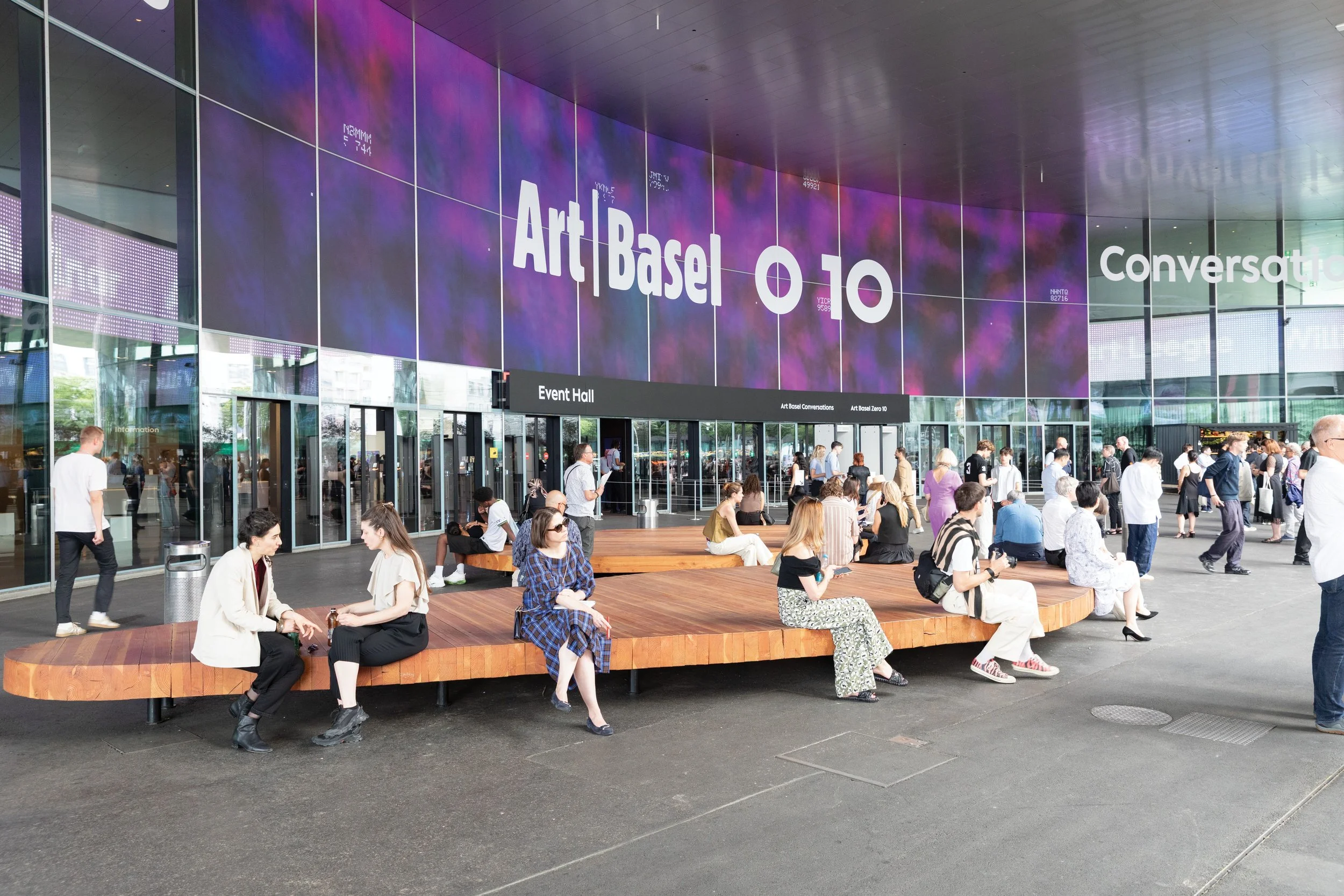
There is a particular fatigue that arrives by the second hall of the main fair.
Art Basel, for all its gravity, is built as a system of corridors. It is efficient, legible, optimised for transaction, and almost constitutionally hostile to lingering…
Conversation happens in spite of the architecture rather than because of it.
Unlimited is the reprieve, the one place where scale is permitted to do its work and a body is allowed to stand still. In its first Basel edition, Zero 10 was the other.
That matters more than it sounds, because the section's argument is fundamentally spatial.
Curated by Trevor Paglen and Eli Scheinman under the banner The Condition, Zero 10 advanced a claim by now familiar to anyone who has spent real time in this field, and still faintly heretical to everyone who has not: that digital art is not a category but a condition.
The painter working in Photoshop and the sculptor rendering a maquette before casting it are already inside that condition.
On this reading, the only thing separating a 1961 oscillon from an on-chain generative work is the half-century of vocabulary we have built in the interval.
Paglen has made versions of this case before: what was new in Basel was the method.
Legibility as strategy
What struck me first about Zero 10 was the intelligence of the curation, and the restraint behind it.
Nothing felt scattered or padded for volume, which is rare in a section pitched at a new audience and tempted, always, to over-explain itself. The selection was deliberate and the editing was tasteful, more interested in the right adjacencies than in the longest checklist. The section recruited art-world heavy hitters and let them sit in the same sightlines as the natives: Andreas Gursky with Sprüth Magers, Avery Singer with Hauser & Wirth, Hito Steyerl with Esther Schipper and Andrew Kreps, Ryoji Ikeda with Almine Rech, placed beside Art Blocks, Fellowship, Asprey Studio and the rest. The effect was continuity rather than hierarchy. Set a canonical name next to a blockchain-native one and the two begin to read as a single lineage, each clarifying the other.
I admired this, and the honest question it raises is about the audience rather than the artists. A pairing like this can read two ways: as a genuine conversation across generations, or as a section that still assumes its newer names need a canonical chaperone before a sceptical room will take them seriously.
As Scheinman framed it to Observer, his approach is tactical rather than ideological: present the work cohesively, draw critical attention to it, then build the historical framework that lets it be discussed in academic terms. That is, more or less, how every new medium has been brought into the record since the industrial revolution. The candour is welcome. The real test is whether the work still needs the scaffolding, and in Basel, mostly, it did not.
The strongest booths in the room were holding their own, owing nothing to the names beside them.
The sharpest version of this objection is not mine. In her Basel dispatch, Anika Meier set Noah Horowitz's stated hopes for Zero 10, drawing in new galleries and new collecting communities, giving a younger generation of artists greater visibility, against what the section actually showed. Where the Miami launch had courted spectacle, Basel reached for names its audience already trusted. The highlights Dazed pulled from the section, as Meier noted, ran almost entirely to established figures, with William Mapan, shown by the platform Art Blocks rather than a gallery, nearly the only genuinely emerging position in the room. I think she is right.
The taste was real. So was the conservatism.
Arrival
You entered through John Gerrard.
His triptych of digital sculptures, generated live and never repeating, turned flare, smoke and light into unhurried reflections on extraction and power. Placing this at the threshold was the smartest architectural decision in the section. Scale is a curatorial instrument, and here it was used to stage a confrontation that the digital art world too rarely makes with itself: the convergence of an environmental conscience with a medium whose infrastructure, its render farms and its chains, carries a real planetary cost. To open with fire and oil rigs is to admit the contradiction at the door rather than hide it behind the work.
The control room
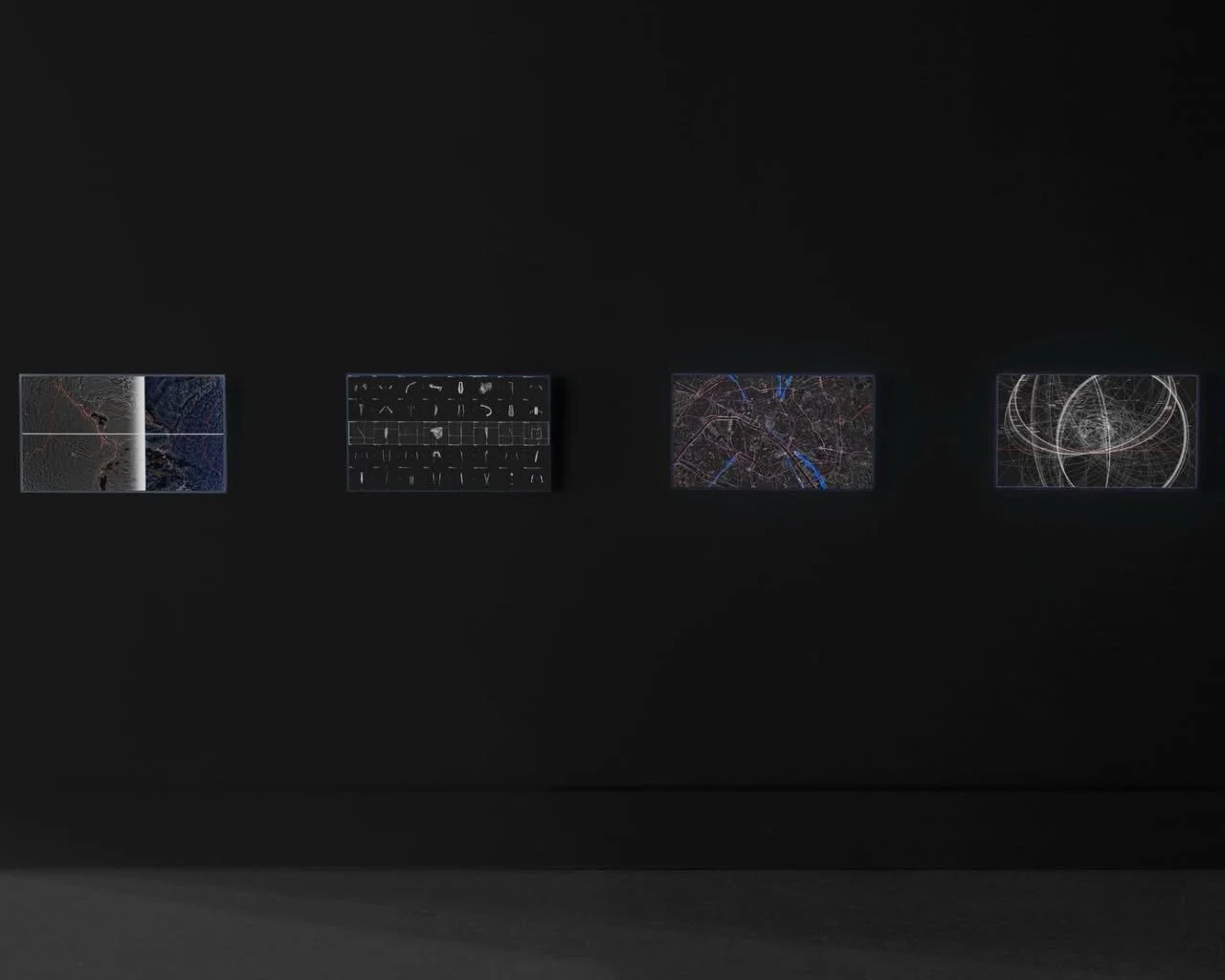
Ryoji Ikeda's data.gram, presented by Almine Rech, was installed in a dark booth that felt less like a viewing space than the operations room of an organisation you were not cleared to enter. This is the data sublime done properly. Built from years of research alongside institutions including CERN and NASA, the wall-mounted sequences compress enormous scientific datasets into something the eye can almost hold into something the eye can almost hold, moving across scales from the quantum to the galactic. What lifts the work above spectacle is its self-awareness. Ikeda does not only render the cosmos legible; he renders legible the politics of legibility itself, the fact that this knowledge is owned, gated, and unevenly accessible.
You leave the booth aware that you have been shown the universe through someone else's clearance.
Lineage made human
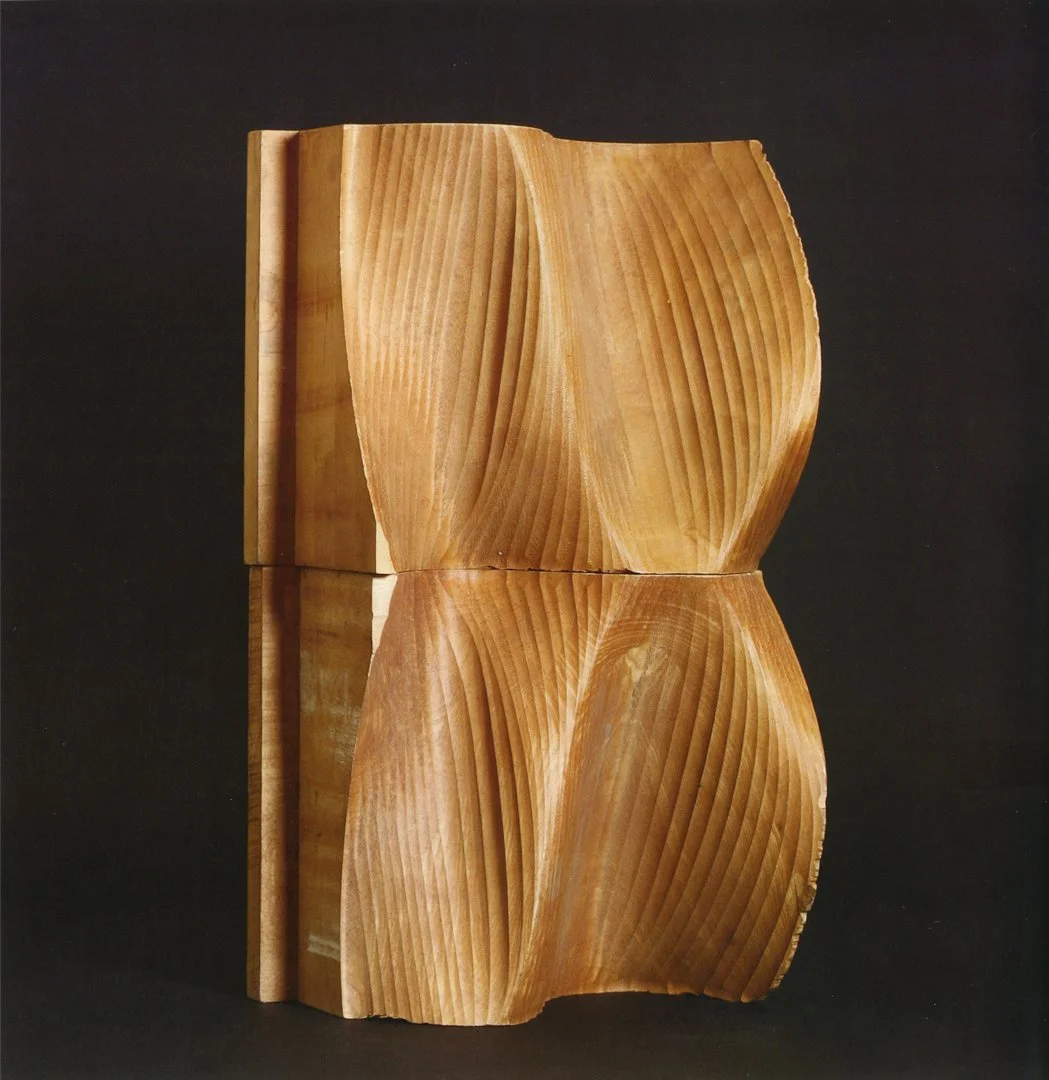
Charles Csuri was, for me, one of the historical anchors of the section, and the experience deepened considerably for having heard his daughter Caroline speak about his life's work at length at the Digital Art Summit, on a panel on canon formation in digital art that Alex Estorick moderated, with Christiane Paul of the Whitney and Margit Rosen of ZKM alongside her.
Numeric Milling (1968) and Random War (1967) are not merely early; they are foundational, among the first three-dimensional objects produced through computer algorithm.
But what Caroline's account restored was the human scale of that pioneering, the biographical behind all of the breakthroughs.
So much digital art history is written as a procession of firsts and technical thresholds… To hear it told as a life is to be reminded that lineage is not as simple as an abstraction, it is people, teaching, succession, and the long patience of being right before the institutions agree.
I was deeply moved by both the work and the history of the man behind it.
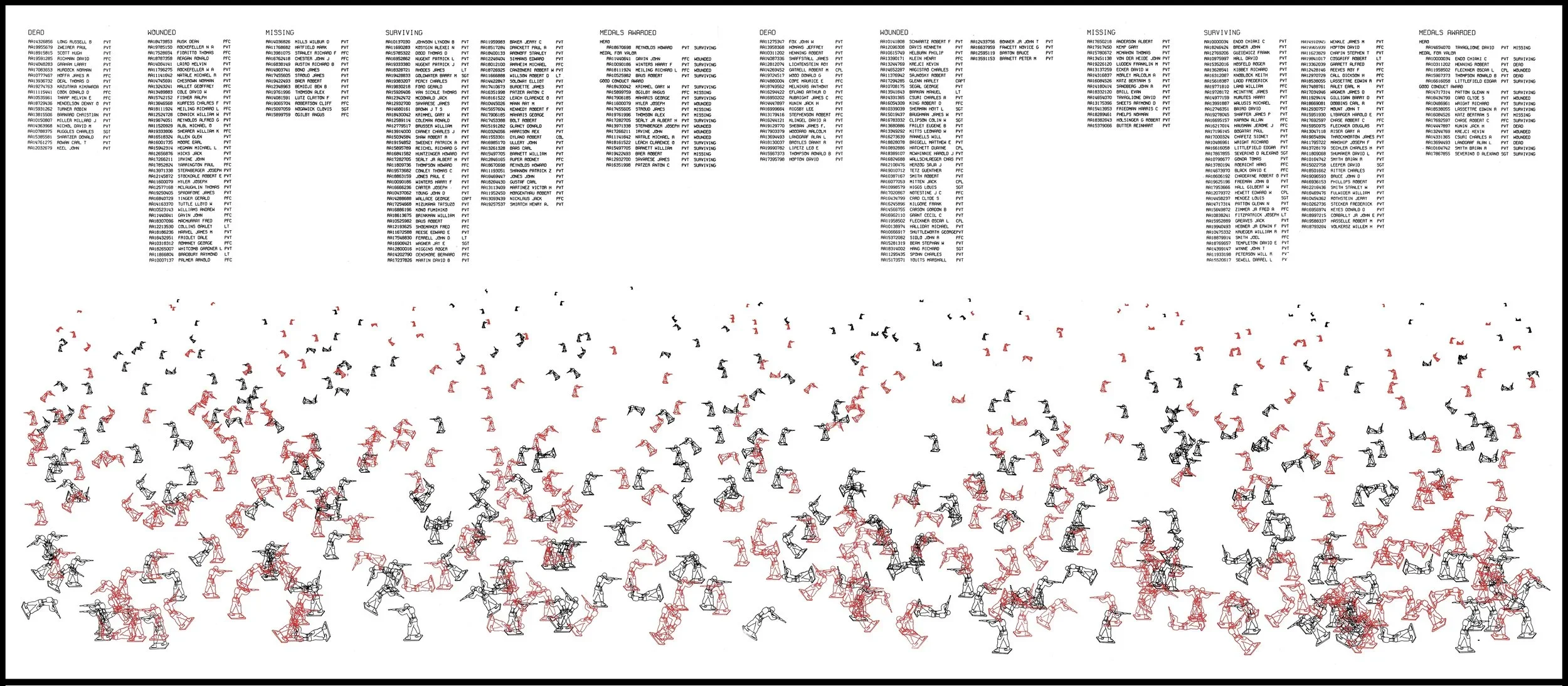
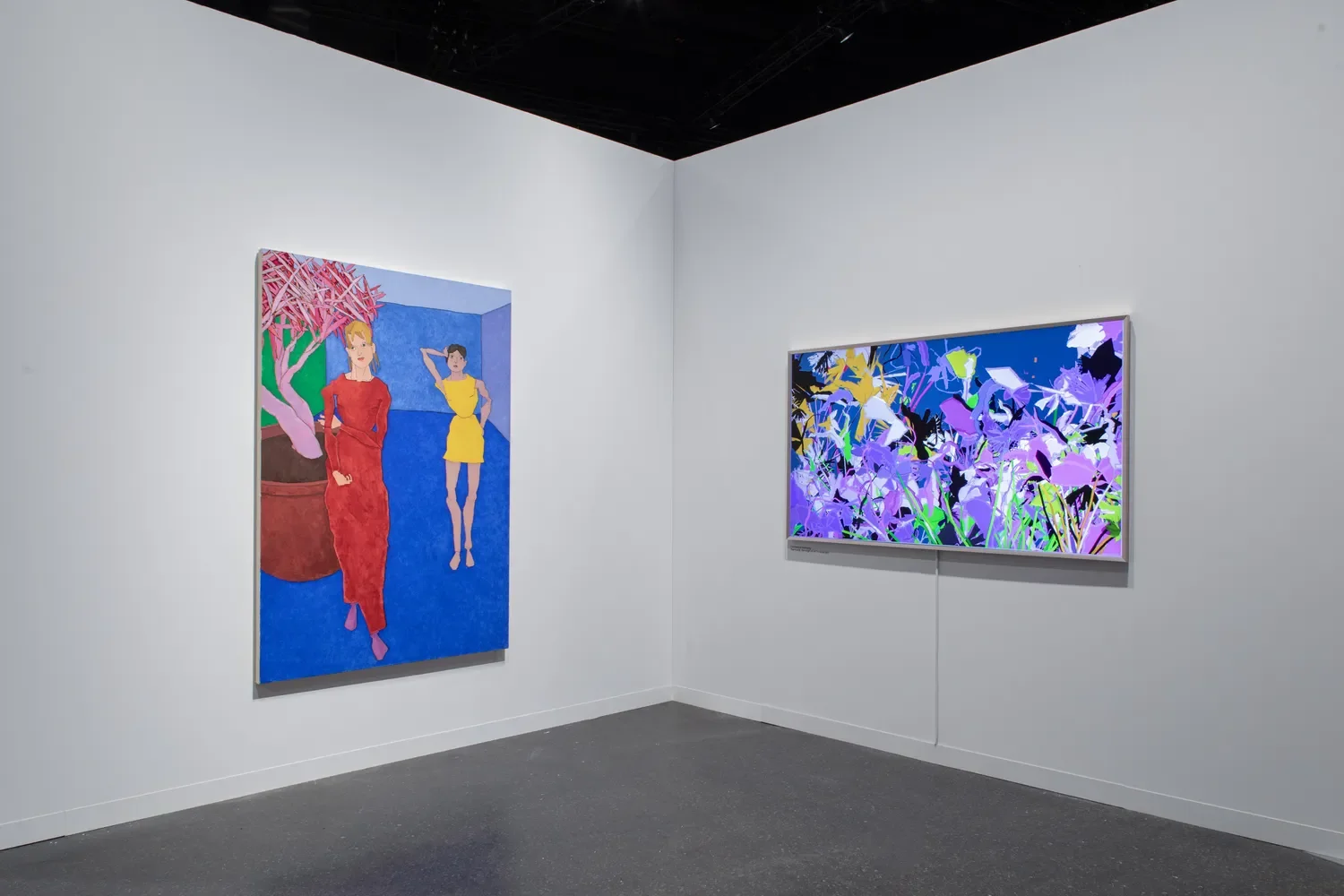
The other pioneer I kept returning to was Harold Cohen, with Gazelli Art House.
Cohen represented Britain at the 1966 Venice Biennale as a painter, then spent the rest of his life, until his death in 2016, building AARON, one of the earliest autonomous systems for making art, which he taught to draw and paint and went on refining for nearly fifty years.
The presentation hung his own paintings beside AARON's, and the effect was quietly astonishing: not a man replaced by his machine but a man in conversation with one he had made, across decades, each learning from the other.
The pictures themselves are beautiful, looser and warmer than the word "algorithm" prepares you for, full of a colour sense no rule set fully explains. Standing in front of them, the authorship question that haunts the rest of the section felt less like a crisis and more like a relationship, one Cohen had been living inside long before the rest of us thought to panic about it.
Touch
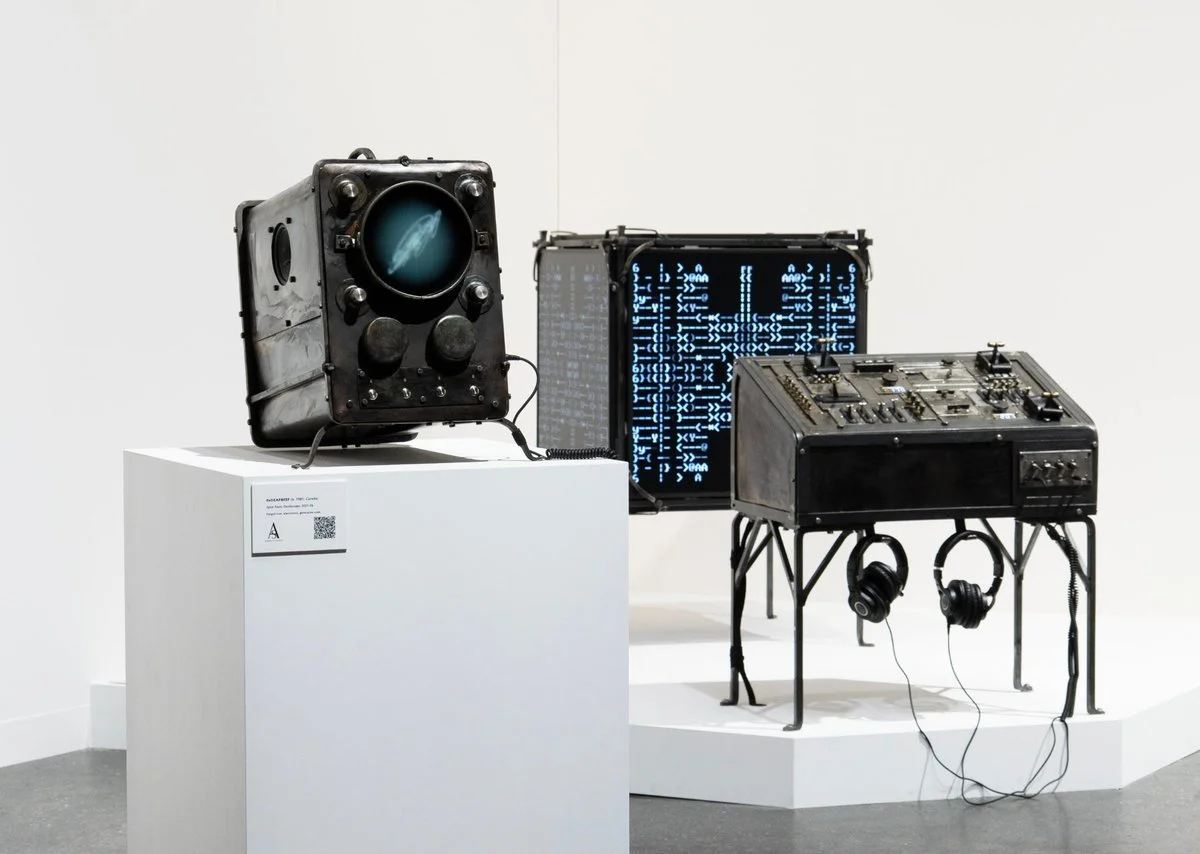
0xDEAFBEEF, the Toronto artist-engineer Tyler DeWitt, was the work I kept returning to.
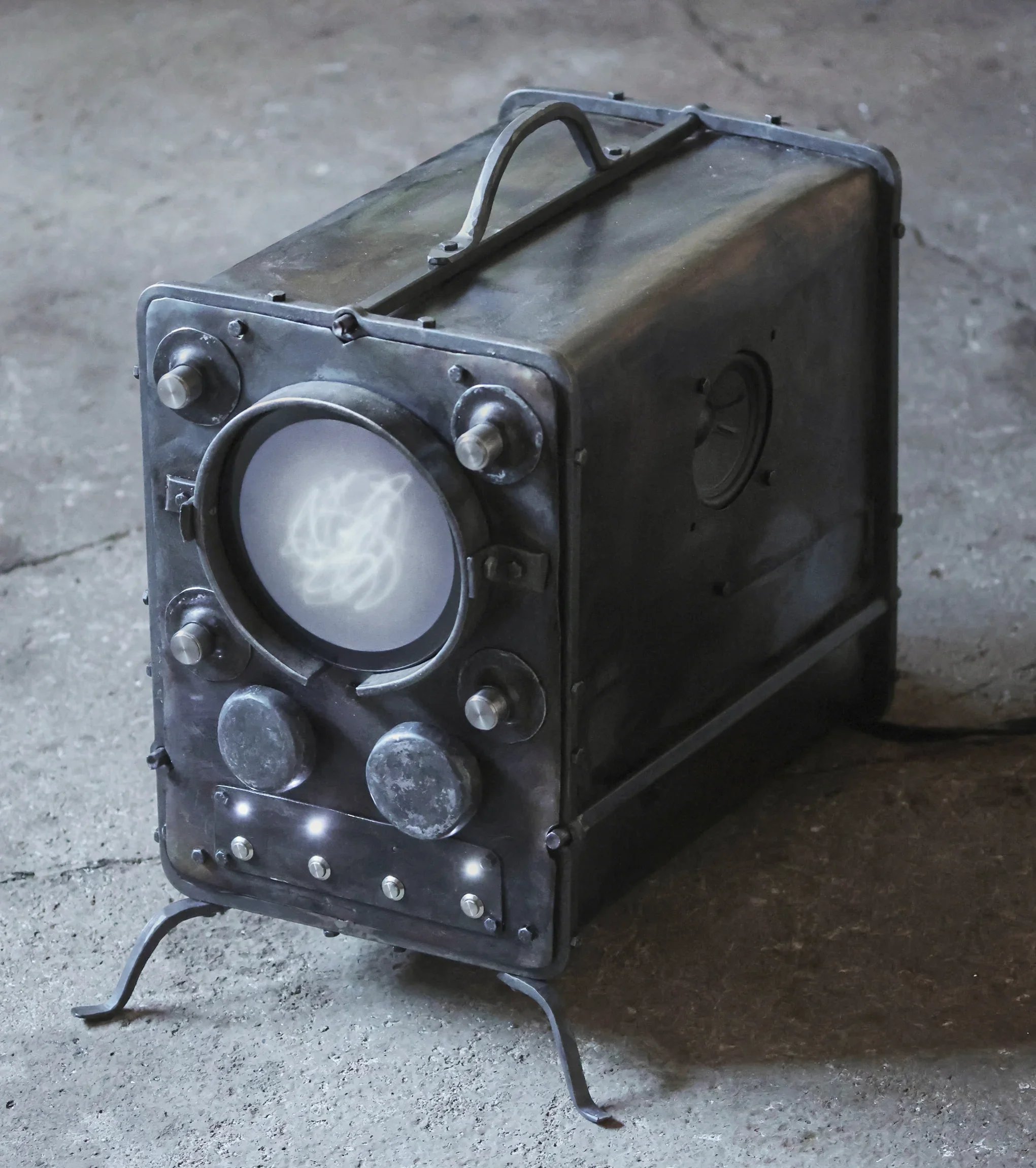
His solo presentation with Asprey Studio paired the Synth Poems, on-chain audiovisual works each generated from a unique hash at the moment of minting, with forged-iron oscilloscopes he made himself, the hammer marks left visible as proof of process.
The forged iron is the point: it carries the evidence of the hand, an almost anachronistic industrial presence inside a field that prides itself on dematerialisation and minimalism.
What he articulated in conversation stayed with me more than any wall text in the section.
The blacksmith and the coder share a condition: both must first build the tools with which they will then build the work.
Craft, in his framing, is not nostalgia, as much as it is a way of insisting that touch survives translation, that it is still there in the digital, that the body has not been edited out of the process. In a room organised around the argument that all art is digital art, 0xDEAFBEEF made the more interesting counter-argument, which is not a contradiction at all: that the digital, at its best, is also material, also forged, and also tired in the hands at the end of the day.
The booth threaded that conviction into a longer lineage.
Two original Ben Laposky prints, the oscilloscope waveforms he called Oscillons in the 1950s, one of which lives in the V&A, hung near DEAFBEEF's own Chronophotographs, Eadweard Muybridge's motion studies reworked and seeded on-chain.
Glitchbox, a programmable instrument of iron and electronics, could be played like a modular synth, every adjustment written immutably to the chain.
Legible, and sold
William Mapan's booth, presented by Art Blocks, sold out within the first hour.
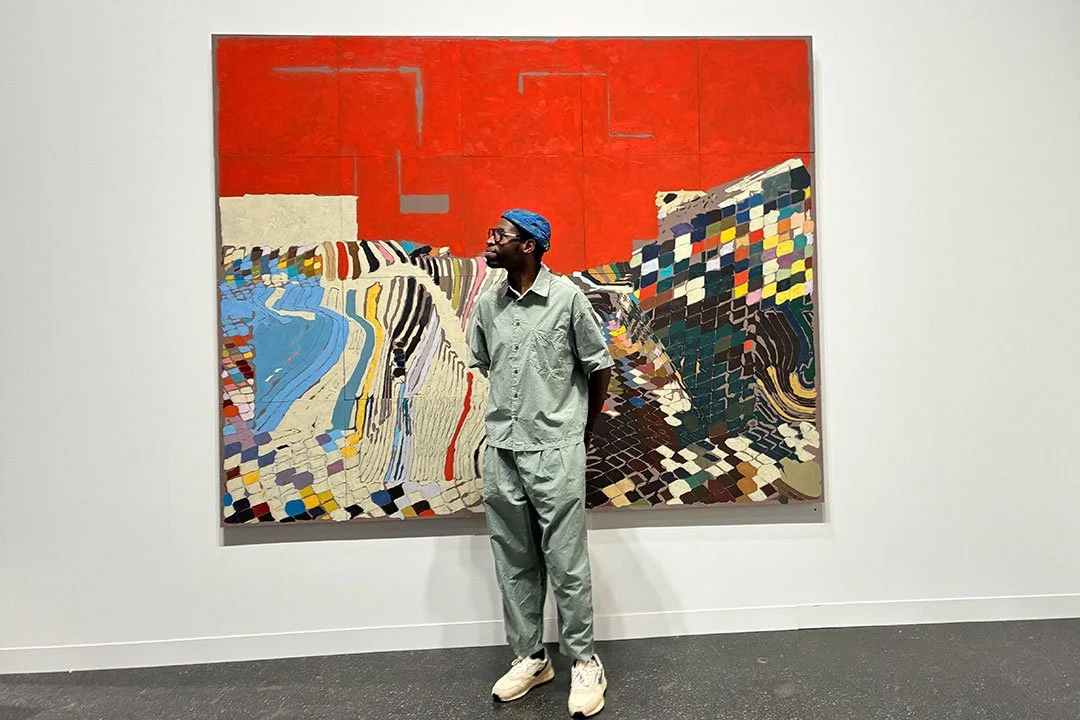
I am close enough to his practice to be a partial witness, so take the enthusiasm with that knowledge, but the sellout was not the achievement. The achievement was that the work was legible to people who arrived sceptical, and that it carried the section's whole argument inside a single booth.
Paysages Plausibles is the result of roughly nine months spent building an algorithm out of his own research into texture, form and space, a bridge he has built between his code and his paintings. The series lives in two states. The oil paintings are landscapes seen as if from a distance; the plotter drawings, Dances on Shadows, are the same terrain zoomed in.
At the centre stood État des lieux, his largest oil to date, two metres by two and a half, assembled from twenty hand-painted wood panels, and Mapan places it openly in the line of Hockney's A Bigger Grand Canyon (1998).
The reference is earned. Like Hockney, he refuses a single vantage point: each panel looks from a slightly different angle, so the eye cannot settle on where the landscape begins or ends. He has spoken about the effect that David Hockney 25 at the Fondation Louis Vuitton had on him last year, and you can see the licence he took from it, the permission to fragment and to enlarge.
What persuaded me was the refusal to let the technology become the subject: the plotter drawings are built from two layers, a plotted landscape underneath and, over it, pastel worked onto tracing paper, so the machine's line comes back roughened into something that reads as made by hand.
Dances on Shadows let visitors explore the algorithm, choose an iteration, and watch a plotter draw it on the spot, each one taking around two hours, folding the viewer into authorship without making a spectacle of the gesture. Mapan calls it "a drawing machine executing as William's brain," and the phrase is exact: fifteen years of sketching in the morning and coding in the afternoon have worn away the distance between his hand and his code.
At his Paris show last autumn, visitors kept asking where the code was, and he took the question as the proof he wanted. The medium had finally stopped being the point.
The heartbeat
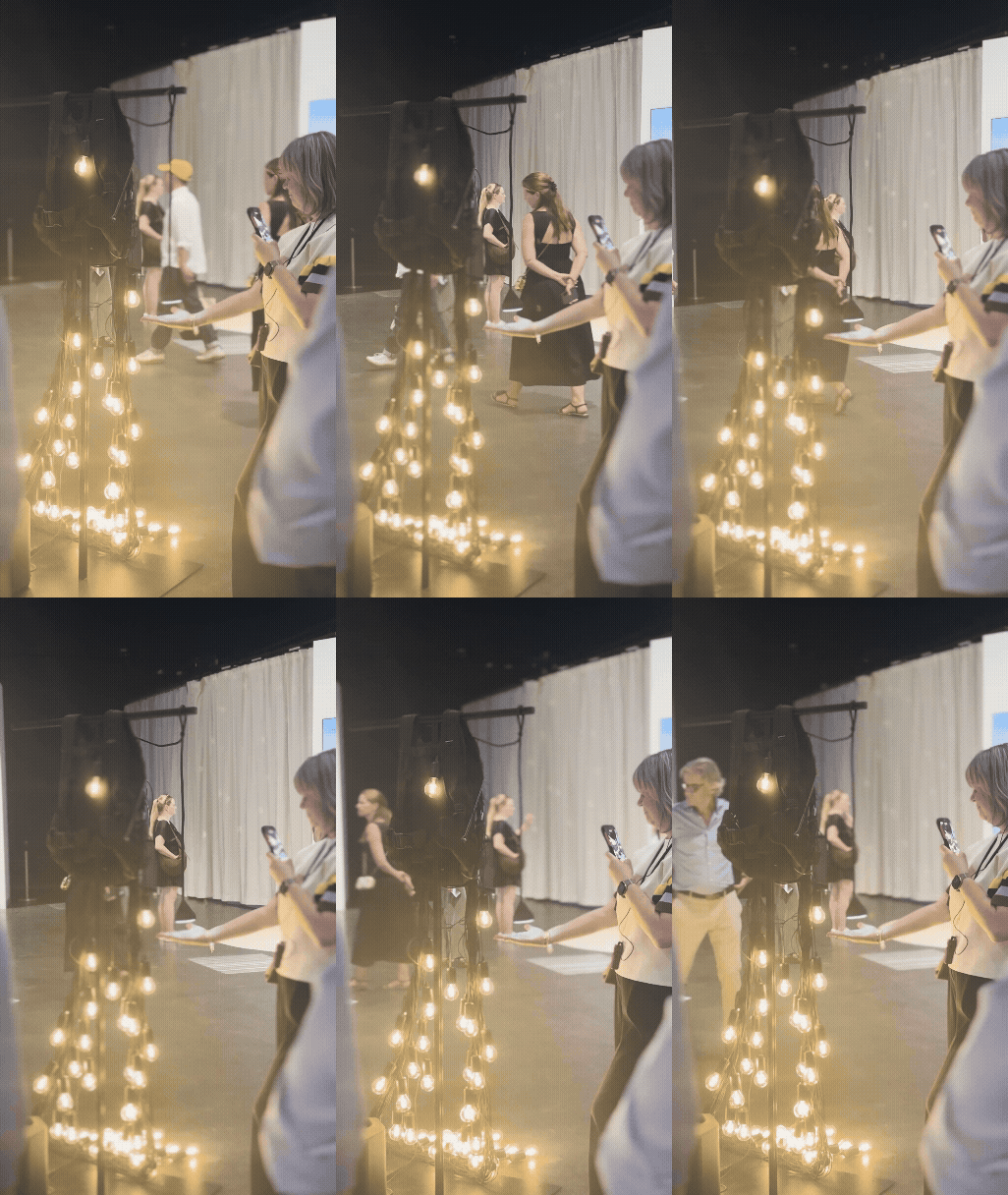
The work I found most moving in the section was Rafael Lozano-Hemmer's Pulse Agglomerate, shown with Galería Max Estrella and bitforms. I want to be careful here, because it is easy to be sentimental about a piece that is itself an instrument for sentiment, and this one earns its emotion through structure rather than asking for it.
Pulse Agglomerate began as a biometric memorial performance at the 60th Venice Biennale in 2024. A performer wore an armature that powered and hauled hundreds of lightbulbs, each one glimmering to the recorded pulse of a different person, and walked the streets of Venice gathering one hundred heartbeats as it went.
The oldest recordings, present at the start of the performance, came from Lozano-Hemmer's 2013 Pulse Room at the IZOLYATSIA Foundation in Donetsk, captured shortly before armed representatives seized the territory.
The foundation had to relocate to Kyiv; its original site was occupied and destroyed.
As each new participant added a pulse through the onboard sensor, the freshest heartbeat displaced the oldest. The work is therefore a memorial that refuses to hold still. It does not embalm the dead so much as carry them forward and, in time, let them go, replaced by the living who came to stand in front of it.
What undid me was precisely the interactivity, and what it does to the relationship between art, artist and viewer.
To add your pulse is to be briefly inside the work, and then, by the work's own logic, to begin leaving it, since someone after you will displace you in turn.
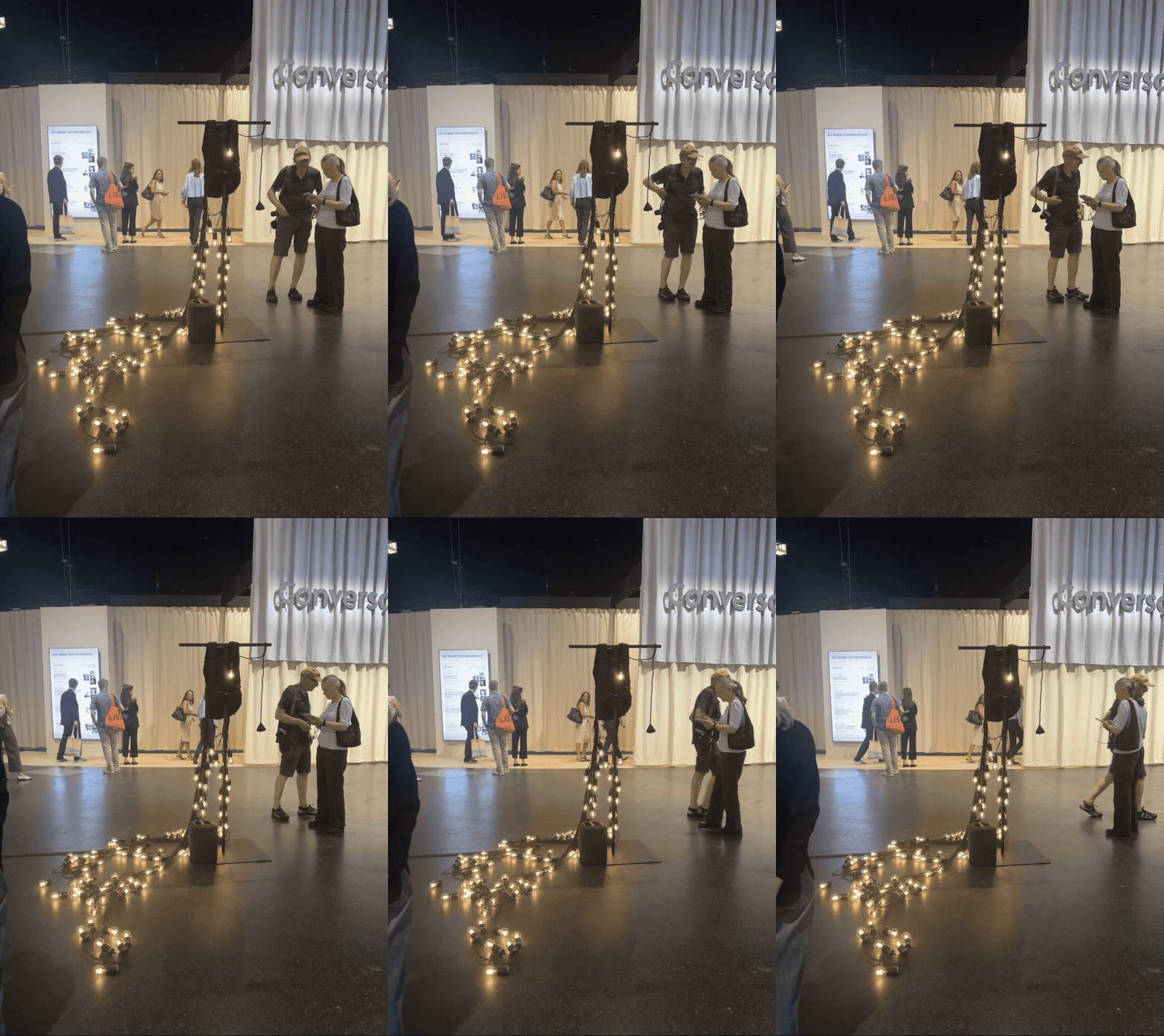
That is not a gimmick. It is the formal shape of grief and continuity held in one gesture. You are taken in, and you are released.
Lozano-Hemmer has built an entire practice on the heartbeat as the most intimate possible datum, the one signal that is unmistakably yours and yet, in the end, identical to everyone else's, and here he turns that paradox into a politics: a count that insists on being a roll of the living rather than the dead, made under the pressure of a war that has not stopped.
The lineage the work claims is exact, and worth naming because it is where the piece locates its seriousness:
In 1956 the Gutai artist Atsuko Tanaka encased herself in Electric Dress, a costume wired from hundreds of coloured bulbs, the body lit up and quietly imperilled by its own circuitry.
In Roberto Gavaldón's Macario (1960), a famished man slips into delirium and sees every living person as one flame among thousands burning in a cave, each guttering its own small death.
In 1972 Jack Goldstein had himself buried in the earth with a stethoscope at his chest, each beat relayed to a lamp on the surface that pulsed in time, life signalled from below.
Pulse Agglomerate gathers all three: the lit body, the single flame among the many, the heartbeat as the last proof that someone is still here.
To stand in front of it in Basel, ringed by transactions, and to give it your pulse, was the closest the fair came to something sacramental.
The dark sea
If Pulse Agglomerate was the section's elegy, Agnieszka Kurant's Alien Internet, with Marian Goodman, was its most beautiful provocation.
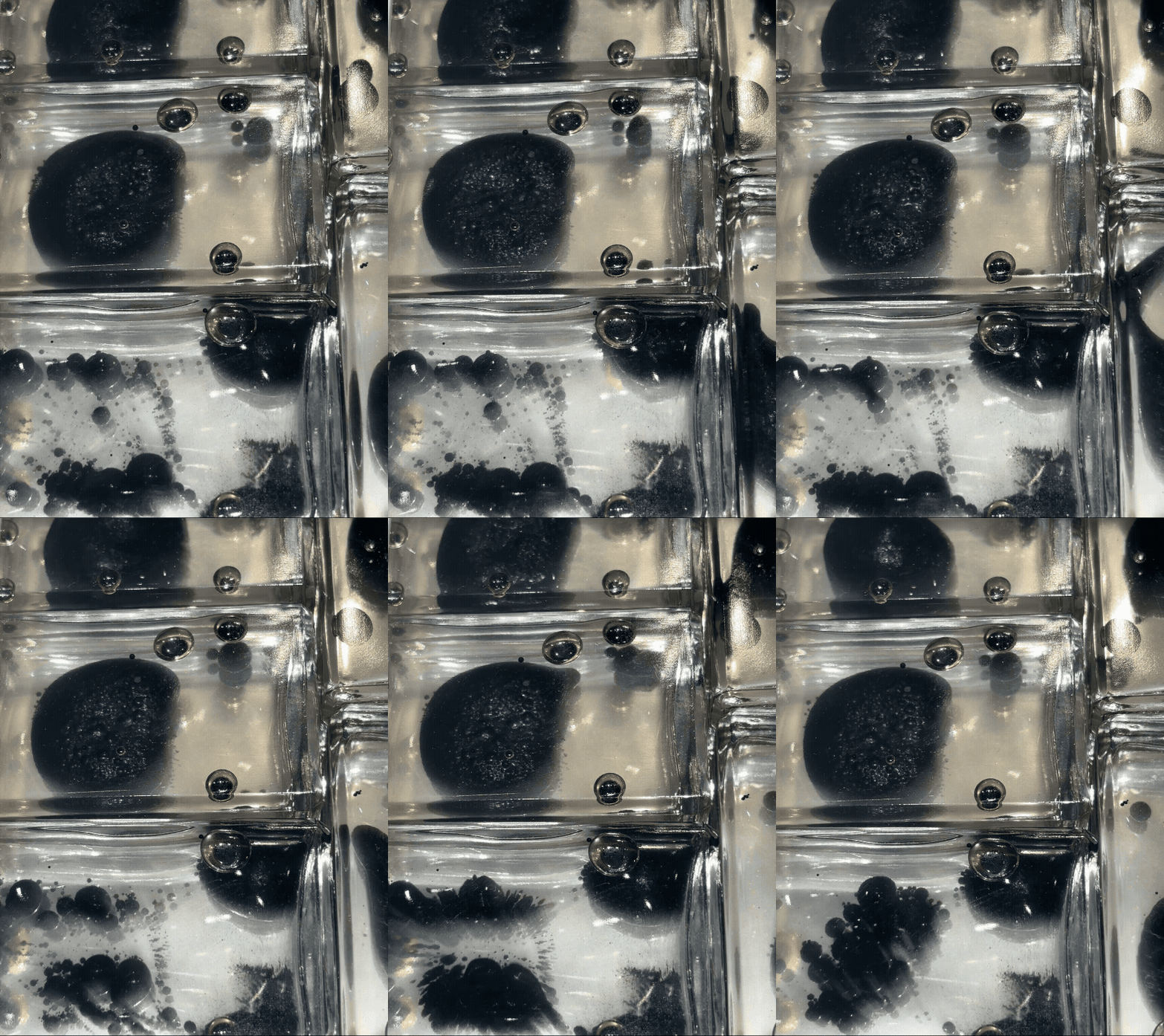
From a distance it reads as a minimal glass cube on a plinth. Up close it is a small black sea in perpetual unrest: globules of ferrofluid, the black magnetic substance NASA developed in 1963, congealing, splitting and reforming inside the glass.
The electromagnetic field driving it is fed with data drawn from the behaviour and communication of millions of tracked wild animals, whales, birds, turtles, sponges, and other non-human organisms monitored by scientific institutions across the planet.
The conceit is that these creatures, taken together, already behave like something close to a living computer, a distributed intelligence whose collective signals can flag a coming eruption or quake, a tsunami, an outbreak, before it surfaces.
Alien Internet gives that planetary nervous system a body you can watch.
On one level it is gorgeous, a dark tide breathing in a vitrine. On another it is a quiet indictment, since the same surveillance that lets us read the animals also conscripts them, turning whales and birds into unpaid sensors in an economy that harvests their cognition for human forecasting and human profit.
Kurant has spent a career on collective and nonhuman intelligence, and here the entire inquiry is condensed into a single shape-shifting form that asks what we actually learn when we wire the living world to our predictions.
It is the rare object that pushes the limit of what is physically possible to make while keeping its politics fully intact, and it belonged in the same room as Ikeda's data and Gerrard's fire: three works, in the end, about the cost and the opacity of knowing.
The unfinished argument
The section did not resolve its hardest questions, and to its credit it did not pretend to.
Paglen and Scheinman were candid before the fair that the obstacles are not technical but institutional… Accreditation lags. Curators and scholars trained on the distant past retreat, as Paglen put it, to a safe nineteenth-century shore when confronted with technology they suspect they do not understand.
Institutions were built to hang things on walls, and many of the works here resist hanging entirely; they ask to be participated in, stewarded, or hosted rather than owned.
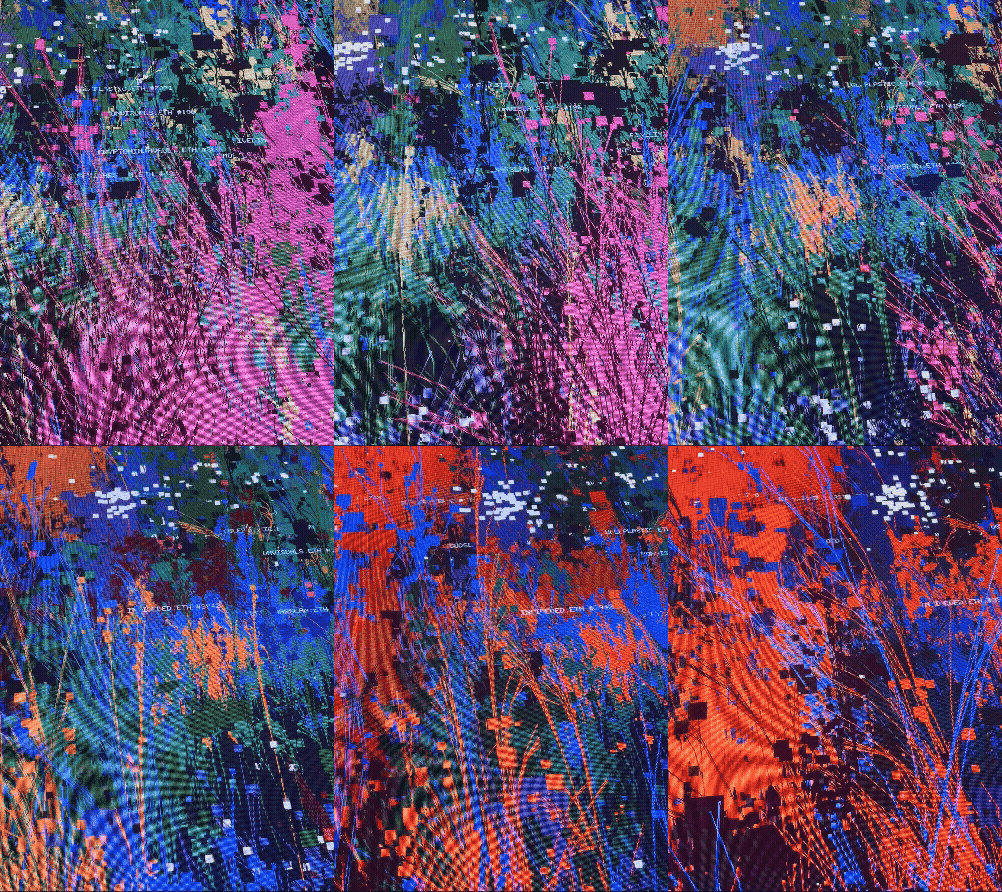
Leander Herzog's Infinite Garden, at Nguyen Wahed, made the point literally: a blockchain-based ecosystem that turned collectors into participants, each one adding to a shared, ever-changing garden, so that the network itself, and not any single object, was the work. It is the clearest case the section offered for blockchain as stewardship rather than speculation, a structure for collective authorship that a wall and a label cannot hold.
The authorship question hovers over everything, sharpened by AI, asking why we still need the artist when the prompt appears to do the work.
Paglen's answer is the right one and an old one: the creation of art is producing the language and the story around the object, not only the object. A prompt may be someone's art without being good art. The distinction is connoisseurship, which is precisely the faculty the section claimed to be defending.
It helps to remember the ground Zero 10 is standing on. The speculative boom that once put this work on front pages is well and truly over. DappRadar's numbers put trading in art NFTs near three billion dollars at the 2021 peak and at a sliver of that by early 2025, and the platforms emptied out as the money did: Foundation dormant, MakersPlace and KnownOrigin shut, Christie's having folded its dedicated digital department back into its contemporary sales, NFT Paris cancelled with little warning. A digital programme this serious, inside a fair of this rank, has become an outlier, and that scarcity is exactly what makes the section's gravity read as a stance rather than a fashion.
Charlotte Kent, writing in Right Click Save, caught an asymmetry in the conversation around the section:
Everyone wondered whether the main fair would make the trip across, since Zero 10 sat in its own hall on the far side of the tracks, to take the digital work seriously. Almost no one asked the reverse: whether Zero 10's own audience and collectors would wander into the main pavilion and leave their attention there. Christiane Paul of the Whitney put the spatial point more sharply, noting that the fair had managed to find room for Unlimited without the same hesitation.
The separation is offered as breathing room, and it is, but it is also a quarantine, and a section that wants to dissolve the category should be wary of a floor plan that keeps redrawing it.
All of which returns me to the tension I cannot fully set down. Zero 10 framed itself as a corrective to hype, a space for connoisseurship over speculation, and yet the narrative that travelled fastest out of Basel was the sales sheet: Mapan's sellout, Gerrard's half-million, the prices climbing into six figures across the booths. That is not hypocrisy. It is the condition Walter Benjamin named almost a century ago, the work of art negotiating its own value in an age that reproduces and prices it in the same breath.
A section cannot dissolve that contradiction by curating around it. The most it can do, and what Zero 10 did, is hold the contradiction in view long enough for it to become a subject rather than an embarrassment.
The hope Scheinman offered is that the distinctions blur until the separate category no longer feels necessary. I think that is correct, and I think Zero 10 was strongest exactly where it forgot to argue the point.
The thesis was carried not by the wall texts insisting all art is digital art, but by 0xDEAFBEEF's iron, Mapan's oil, Cohen's painted machines, Kurant's ferrofluid, and Ikeda's borrowed light: works that were already past the argument, making things, indifferent to whether the institutions had caught up.
Which is the quiet joke the section keeps making and never quite says aloud. Magritte painted a pipe and wrote beneath it that this is not a pipe, because the image of a thing is not the thing. The line Zero 10 was built to defend, the one separating digital art from the rest of it, is the same kind of figure: a picture of a border, drawn after the fact, mistaken for the border itself. Cohen's plotter and Mapan's plotter both lay down a line, and neither line falls where the category says it should.
The wall text can keep insisting on the division.
The work has already crossed it.
Ceci n'est pas une ligne.
Sources
Reporting, quotations from the curators and artists, and sale figures referenced above were originally published in the following. Direct quotes are attributed in the text; factual details (prices, dimensions, dates, gallery pairings) are drawn from this coverage.
Elisa Carollo, "Zero 10 in Basel Contextualized Digital Art Within a Broader Historical Framework," Observer, 22 June 2026.
Thom Waite, "Art Basel: 7 highlights that explore the past and present of digital art,"Dazed, 19 June 2026.
"Art Basel's digital sector returns for its third outing," Unit London, June 2026. (NFT market figures cited via DappRadar.)
Anika Meier, "I Want Digital Art Collectors, But For Myself,"Status Update (Substack), 21 June 2026.
Charlotte Kent, "A Connected Art World Works Both Ways," Right Click Save.
Louis Jebb, "Landscapes of the Mind | William Mapan," Right Click Save.
Margaret Carrigan and Jo Lawson-Tancred, "At Art Basel, Everyone Is Playing It Safe, Eying Market Recovery," Artnet News, 16 June 2026.
Noah Horowitz, "interview,"Artnet (The Art Angle podcast).
Asprey Studio, "Asprey Studio at Art Basel in Basel 2026."
Art Basel, Zero 10 (The Condition), curated by Trevor Paglen and Eli Scheinman: exhibitor roster and programme.
Work descriptions for Rafael Lozano-Hemmer's Pulse Agglomerate and Agnieszka Kurant's Alien Internet draw on the artists' and galleries' published materials.