

The Devotional Ledger
On omentejovem, the iconography of belief, and what happens when a visual diary starts writing scripture
Start with the word, because the painting makes you wait for it.
Cult opens as pure sensation.
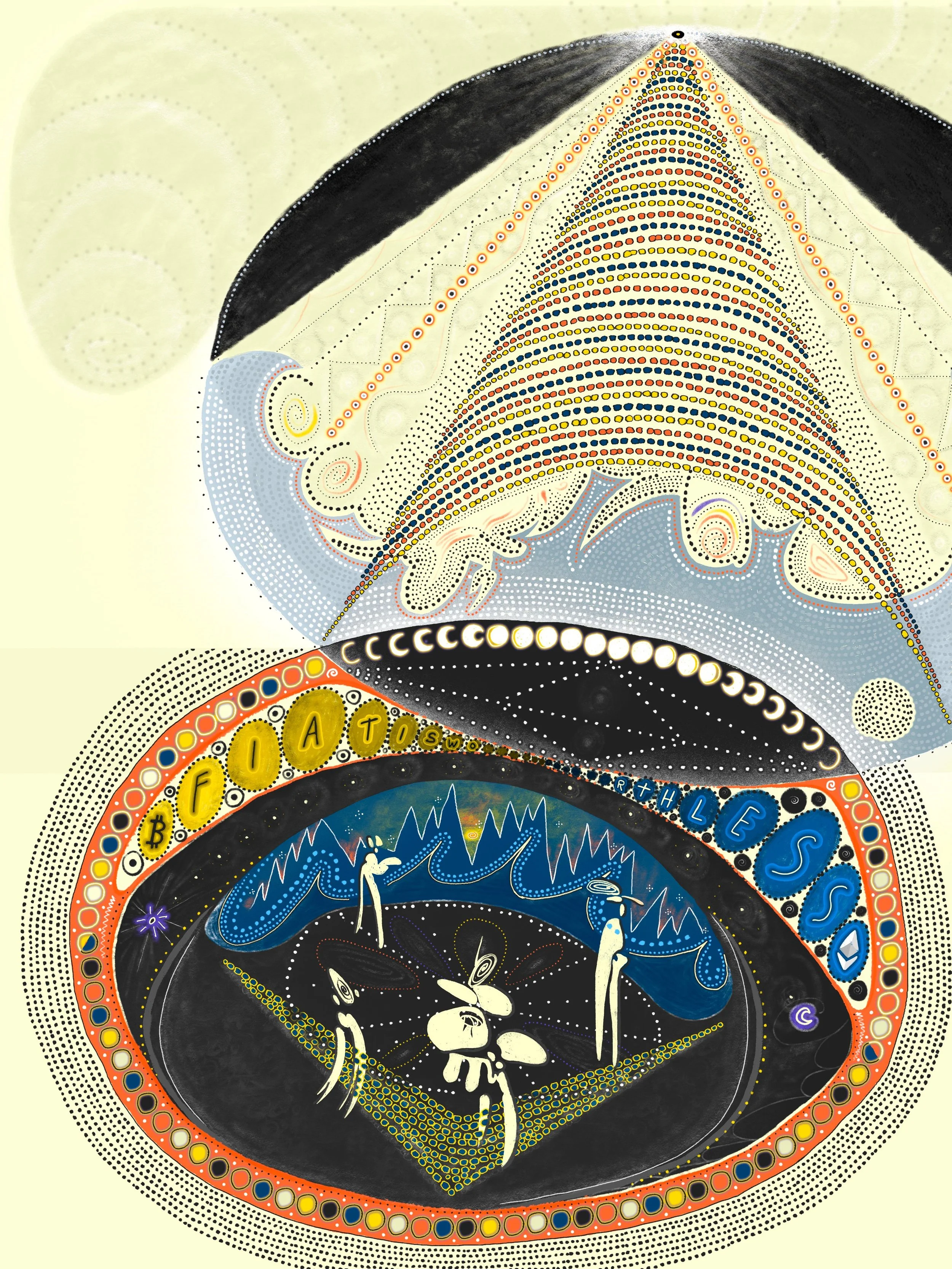
A pale, sun-bleached field. A dark canopy pressing down from above like a lowered eyelid. Between them, a pyramid of beads in orange, yellow, and deep blue, hundreds of them, climbing toward a black apex from which light seems to leak rather than shine. Below, an oval world rimmed in ornament: rings of painted medallions, dotted halos, a horizon of jagged blue mountains stitched in points of light. Inside the oval, a dark arena. White figures stand at its edges, attenuated, faceless, watchful. A crescent of moon phases arcs across the upper rim like a rosary told in silver.
The colours scream before the symbolism does; that is the sequencing of every omentejovem painting worth standing in front of: the palette hits first, the recurring signs resolve second, and meaning, if you insist on it, arrives third. But Cult adds a fourth stage.
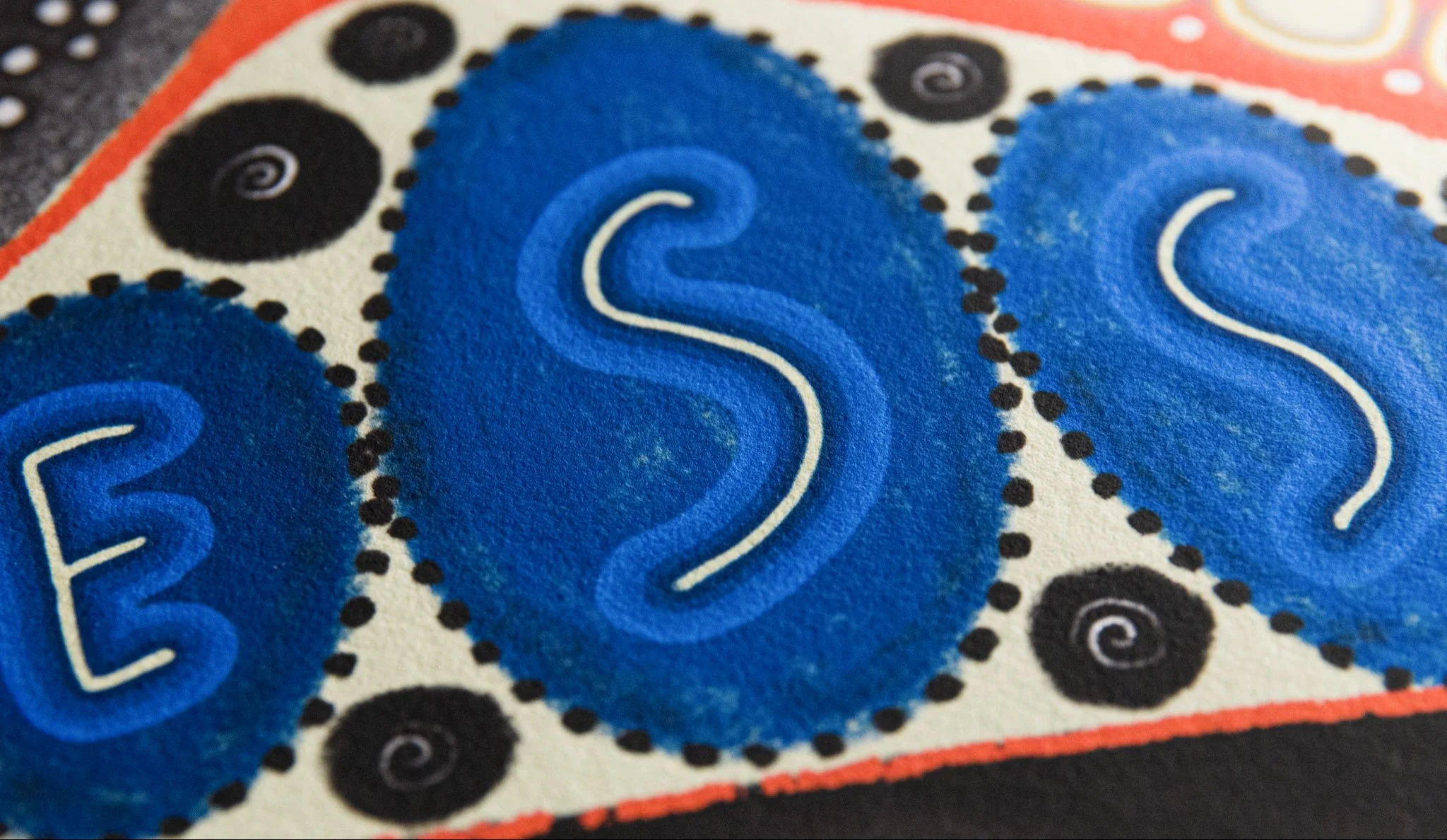
Look long enough at the medallions ringing the pit and the ornament turns out to be text. Letter by letter, gold cell by gold cell, the frame spells it out: FIAT IS WORTHLESS. A Bitcoin mark sits among the letters like a saint's attribute. An Ethereum diamond glints lower down, small and votive.
The piece is called Cult. The piece contains a creed. The question it refuses to answer is whether it knows what it has done.
The pit and the rings
The compositional logic here is old. Concentric registers, a world arranged in rings around a dark centre, abstracted figures stationed at the threshold looking in or looking down: this is the architecture of judgment scenes, of mandalas, of Dante's funnel.
The Inferno is organised exactly this way, a descending sequence of ringed terraces around a pit, each ring inscribed with the logic of what is punished there. Dante even gives his hell a text at the threshold, the inscription over the gate that every reader remembers and most misquote. Cult has a threshold inscription too. It just happens to be a maximalist slogan.
Read that way, the painting becomes a diagram of belief with the believer's own doctrine written into the masonry. The figures in the pit are not obviously suffering. They stand, they gesture, one appears to preside. The mood is closer to congregation than damnation. And this is where the title starts to vibrate.
A cult, from the Latin cultus: worship, tended devotion, the same root as cultivation. The pejorative sense is a late arrival. omentejovem's painting holds both meanings at once, the tended garden of faith and the closed circle of the true believer, and it declines to tell you which one you are looking at.
Whether the artist intends that ambiguity is a fair question, and the honest answer is that intention may not matter.
Thales Machado, who has painted under the name omentejovem since roughly 2021, is by every available account a sincere participant in the belief system his painting depicts. Born in 2001 in the state of Rio de Janeiro, self-taught, he came to art through Photoshop cover designs for rapper friends and came to the market through NFTs in late 2020, when a fellow artist staked him the Ethereum to mint his first piece.
It sold overnight for what he has said amounted to a month of design income. The arc from there runs through SuperRare to the evening-sale ecosystem, Sotheby's and Christie's included, and it is the kind of arc that produces believers. The blockchain did not just sell his work. By his own telling, it made the category of "artist" available to him at all, in a place and a class position where that word had been priced out of reach.
So when Cult inscribes FIAT IS WORTHLESS into its votive rim, the first reading has to be devotional rather than satirical.
This is what the inside of a conviction looks like.
But artworks are often smarter than their painters, reliably, and the title sits on the image like a raised eyebrow. An artist wholly inside the faith does not usually name the congregation Cult. An artist wholly outside it does not spend hundreds of hours placing its beads by hand.
The painting lives in the gap, and the gap is the most interesting territory in his work.
The diary and the diagram
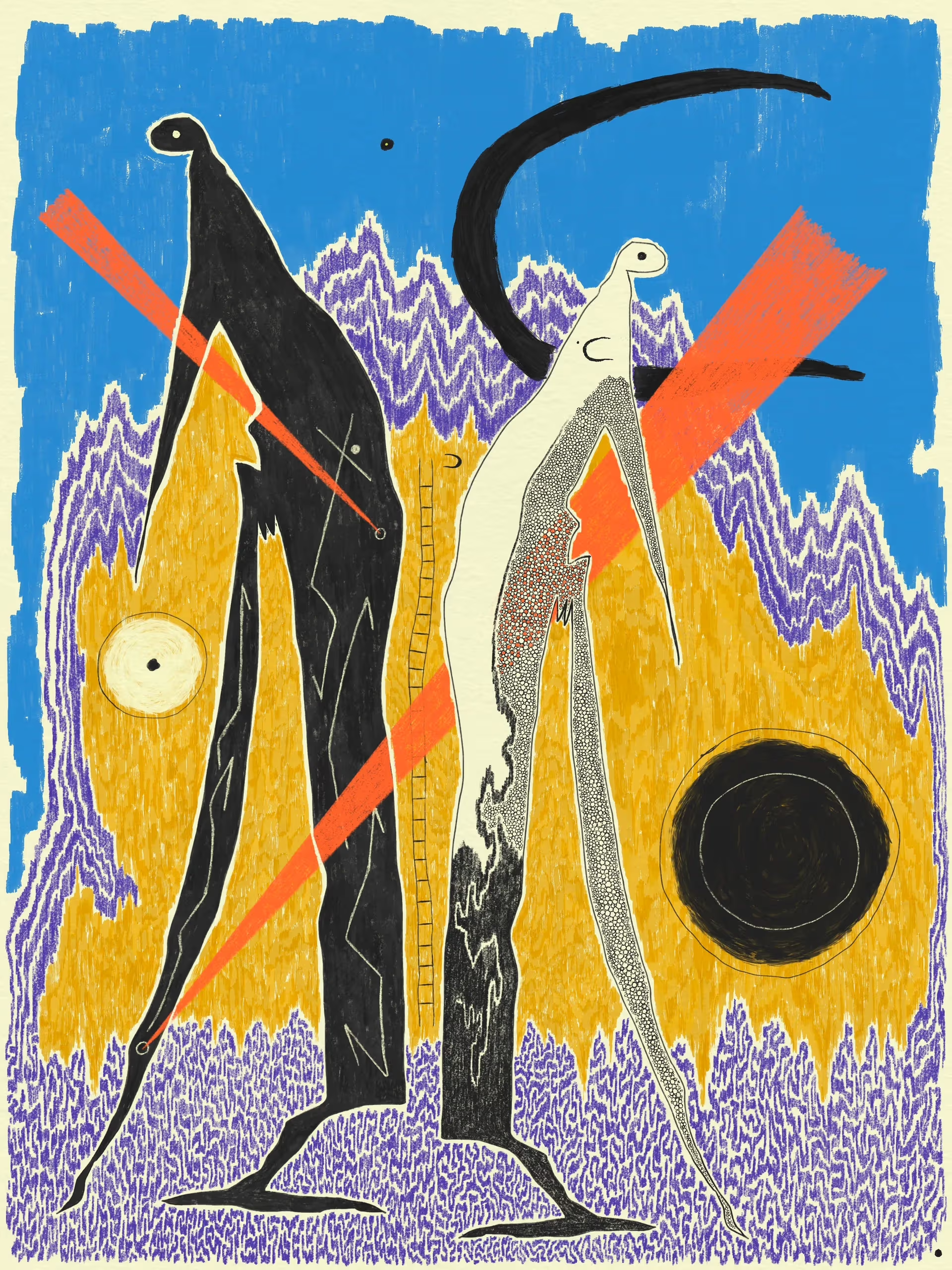
The standard account of omentejovem, repeated across profiles, platform bios, and exhibition texts with the consistency of a press kit, is that his work is a visual diary.
The evidence usually cited is the titles: The Day I Found Out I Can Do Everything, The Day I Felt God, The Day I Met You. Moments of private insight, timestamped and archived. The account is not wrong. It is just insufficient, and it flattens exactly what is strangest about the work.
A diary records, but these paintings systematise: across the 1/1 catalogue, a fixed lexicon repeats with the discipline of liturgy... The moon, usually crescent, often multiplied into full phase sequences; the dot, which the artist describes as a singularity of selfhood, a point of identity held steady against the surrounding noise; the attenuated white figure; the ringed enclosure; the ornamental border that turns out to be load-bearing. Individual paintings deploy this vocabulary the way a religious painter deploys attributes. You do not read Late Night Love or Cult as diary entries. You read them as cosmological diagrams in which a diary entry has been embedded, a private incident promoted to the status of myth.
This is a meaningful distinction, because it locates the work in a different tradition than the one the market copy suggests. Diaries are intimate and disposable. Cosmologies are ambitious and totalising. The titles say diary. The structure says scripture. The Day I Felt God is, on its face, the most diaristic title imaginable, one specific day, one specific feeling. But a painter who returns again and again to the same moon, the same dot, the same ringed world, is not documenting days. He is building a system that can absorb them.
What Miró explains, and what he doesn't
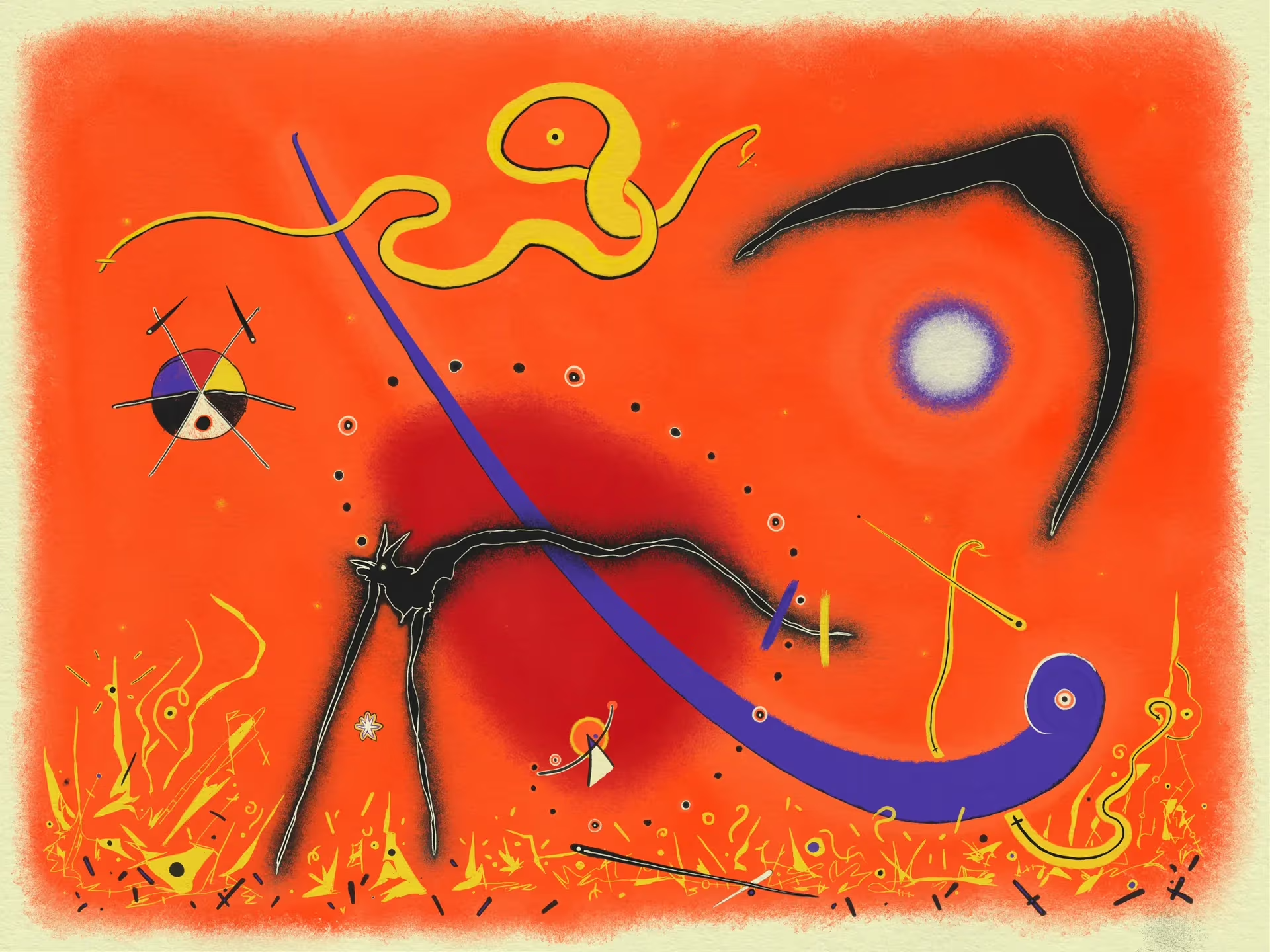
Machado names his references freely: Miró, discovered late; Kandinsky and Picasso, looked up to longer. The Miró affinity is real and visible. The biomorphic line, the floating sign-creatures, the belief that a shape can be a personage, the deployment of colour as an event rather than a description: all of that is legible in omentejovem, and the comparison flatters both parties. Miró too built a private constellation of repeating signs, moons included, and insisted on the primacy of intuition over programme.
But stand in front of Cult and the Miró frame stops explaining things. Miró's fields are open, aerated, calligraphic. omentejovem's are accumulative and dense, built from thousands of discrete marks, dots ringed in dots, borders within borders, ornament pressed into service as structure and as text. The nearer formal relatives are traditions he almost certainly did not study. The concentric registers and diagrammatic cosmos of tantric painting. The obsessive, world-mapping dotwork of Western Desert painting in Australia. The horror vacui and inscribed ornament of Adolf Wölfli, who packed the margins of his invented cosmology with text and musical notation.
Hilma af Klint's conviction that a painting could be a diagram of forces rather than a picture of things.
To be clear about method: this is convergence, not influence. There is no evidence Machado has spent time with any of these traditions, and the claim here is not that he borrows from them. The claim is stranger and more interesting. A self-taught artist in his early twenties, working intuitively from random line toward found form, has independently arrived at the visual grammar that devotional and visionary art keeps producing across centuries and continents: the ring, the register, the accumulated mark, the text absorbed into ornament. That grammar appears to be what belief looks like when it draws. omentejovem did not learn it. He needed it, and it came.
His own account of his process supports this reading. He has described his method as a battle between error, spontaneity, and intention: random lines thrown down, then interrogated until a figure or a world announces itself. It is the procedure of the automatist, and it is also the procedure of the visionary, who does not compose an image so much as receive one and then labour to make it hold. The labour is the tell. Intuition supplies the armature of these paintings in minutes. The dots take weeks. That ratio, instant revelation followed by long devotion, is the ratio of religious practice, and it is built into every surface he makes.
The chain as church

Which returns us to the creed in the frame. It has become a reflex of criticism in this field to treat crypto iconography in crypto-native art as either cynical fan service or unexamined ideology, and both reflexes should be resisted here, because neither survives contact with the biography. Machado's relationship to this technology is not a position. It is an origin story.
The kid working nights on his brother's computer in the family living room, waiting for the household to sleep so the machine would be free, is not performing gratitude when the paintings canonise the systems that ended that arrangement. Titles elsewhere in the catalogue, All Time High Discovery, Mistakes Were Made in a Wallet I Control, Out of Babylon, read less like market commentary than like entries in a convert's memoir, complete with the convert's characteristic blend of triumph, superstition, and debt.
Out of Babylon is worth pausing on, because it gives the theology away.
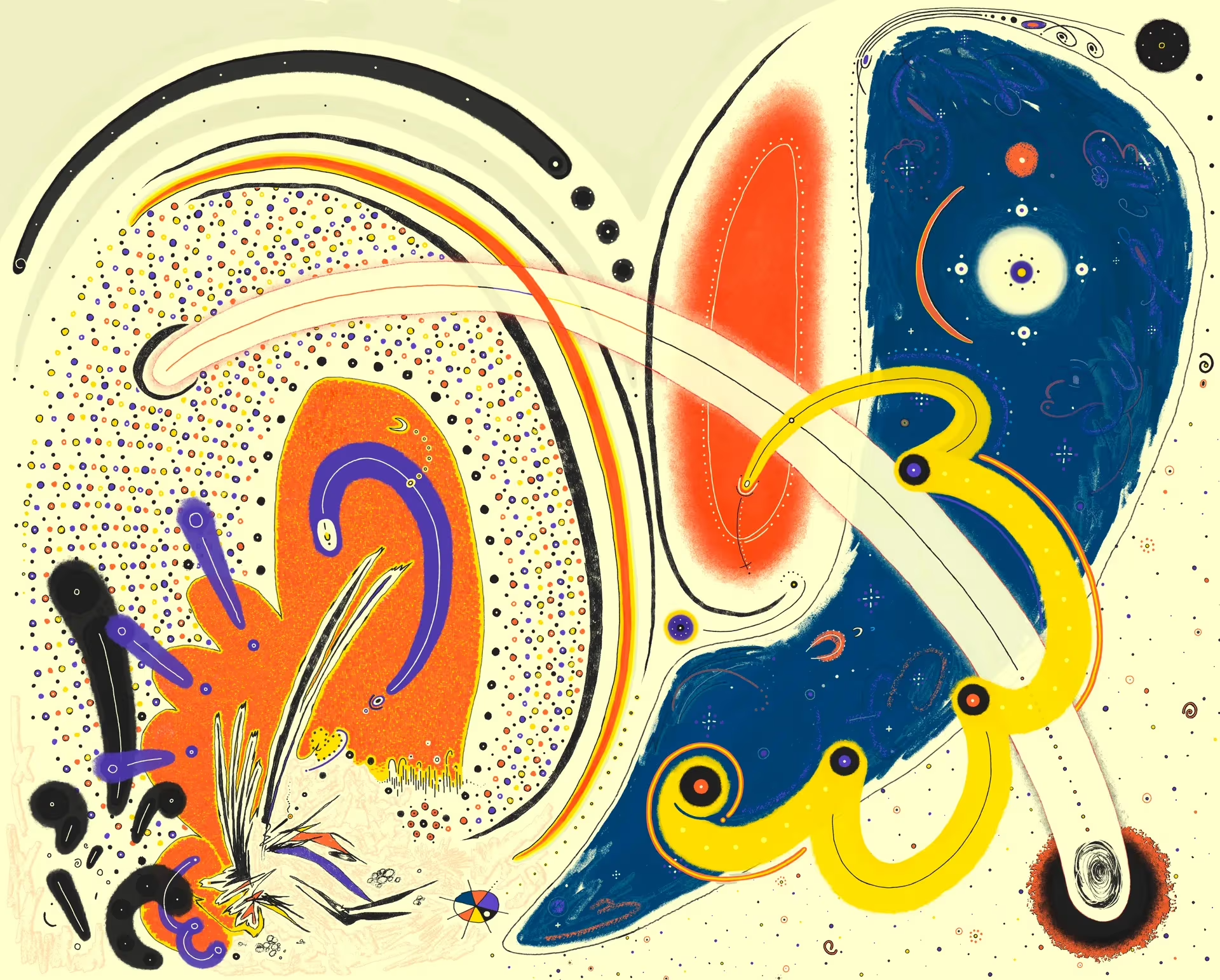
Babylon, in the register Machado would have absorbed growing up in Brazil's musical and spiritual atmosphere, is the Rastafarian and broadly diasporic name for the extractive order, the system that must be exited.
FIAT IS WORTHLESS is the same sentence spoken in a different dialect. The paintings are consistent on this point across years: there is a fallen system and a redeemed one, an old money and a new covenant, and the artist's own deliverance is the proof text. This is not analysis of crypto. It is soteriology, a doctrine of salvation, with the blockchain in the role of the saving instrument.
The critical question is whether the work can see its own theology, and Cult is the strongest evidence that it can. Everything else in the catalogue practices the faith. This painting names it, frames it, rings it with ornament, and stations witnesses around it. Perhaps the title is naive, a young artist reaching for a punchy word. Perhaps it is fully knowing. The painting functions identically either way, and that is not a dodge but the finding: omentejovem has made an image that works as icon for the believer and as anthropology for the sceptic, simultaneously, without splitting the difference. Very few artists inside this ecosystem have managed that. Most of its art is either advertisement or autopsy. This is neither. It is a field report from inside a conviction, filed by someone who may or may not know he is reporting.
The young mind and its ceiling
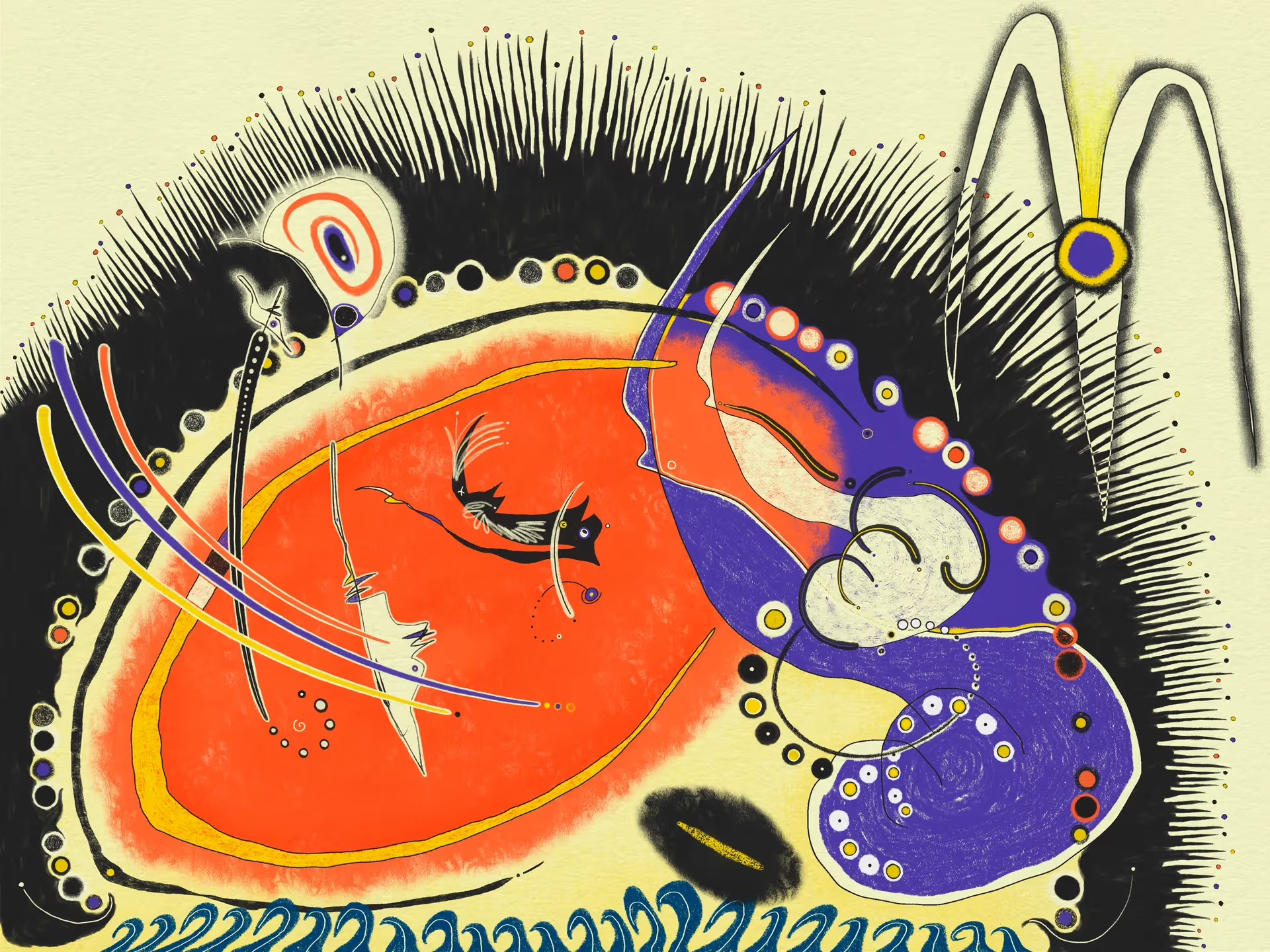
He signs all of this "omentejovem," from the Portuguese o mente jovem, the young mind, a name adopted, by his own account, as a standing instruction to himself: stay open, stay unafraid, decide before doubt arrives.
As artist names go it is unusually honest, because it names the work's engine and its risk in the same breath.
The engine is obvious. The openness is why the paintings feel received rather than designed, why the colour is fearless, why a twenty-something with no formal training can wander into the deep grammar of devotional art without a map. He has said, with the young mind's characteristic absence of hedging, that he intends to be one of the great digital abstract artists of his era. The statement is easy to smile at and hard to dismiss, because the trajectory so far keeps declining to contradict him.
The risk is the mirror of the engine. Systems of private symbols harden. The moon and the dot are, today, a living vocabulary; a decade of repetition could turn them into a logo. Faiths mature or they calcify, and the same is true of the art they produce.
The most hopeful sign is Cult itself, because it demonstrates the one capacity that private cosmologies usually lack: the ability to turn around and look at the believer. An artist who can paint his own congregation, name it accurately, and leave the verdict open has resources beyond intuition. He has begun, whether he would use the word or not, to think historically about himself.
He will have occasion to. In December, omentejovem's work travels with Silk's Chapter 03, the latest station in a career that has moved from a living-room computer to the auction rooms in under five years. The market will keep telling its version of that story, the overnight sale, the month's wage in one morning, the ledger that set him free. The paintings tell a better one. They say that what the technology gave him was not money but a permission structure, and that he has spent every canvas since building the temple that permission deserved. Whether it is a temple or a cult is the question he had the nerve to paint.
Museum Ghost is content to leave it ringed in gold, spelled out one medallion at a time, waiting for the viewer to read the frame.
omentejovem (Thales Machado, b. 2001, Rio de Janeiro) shows with Silk Art House's Chapter 03 in December 2026. His 1/1 catalogue is at omentejovem.com.