

The Candy and the Wire: Bryan Brinkman's Sweetened Systems
I. A rooster in a flour factory
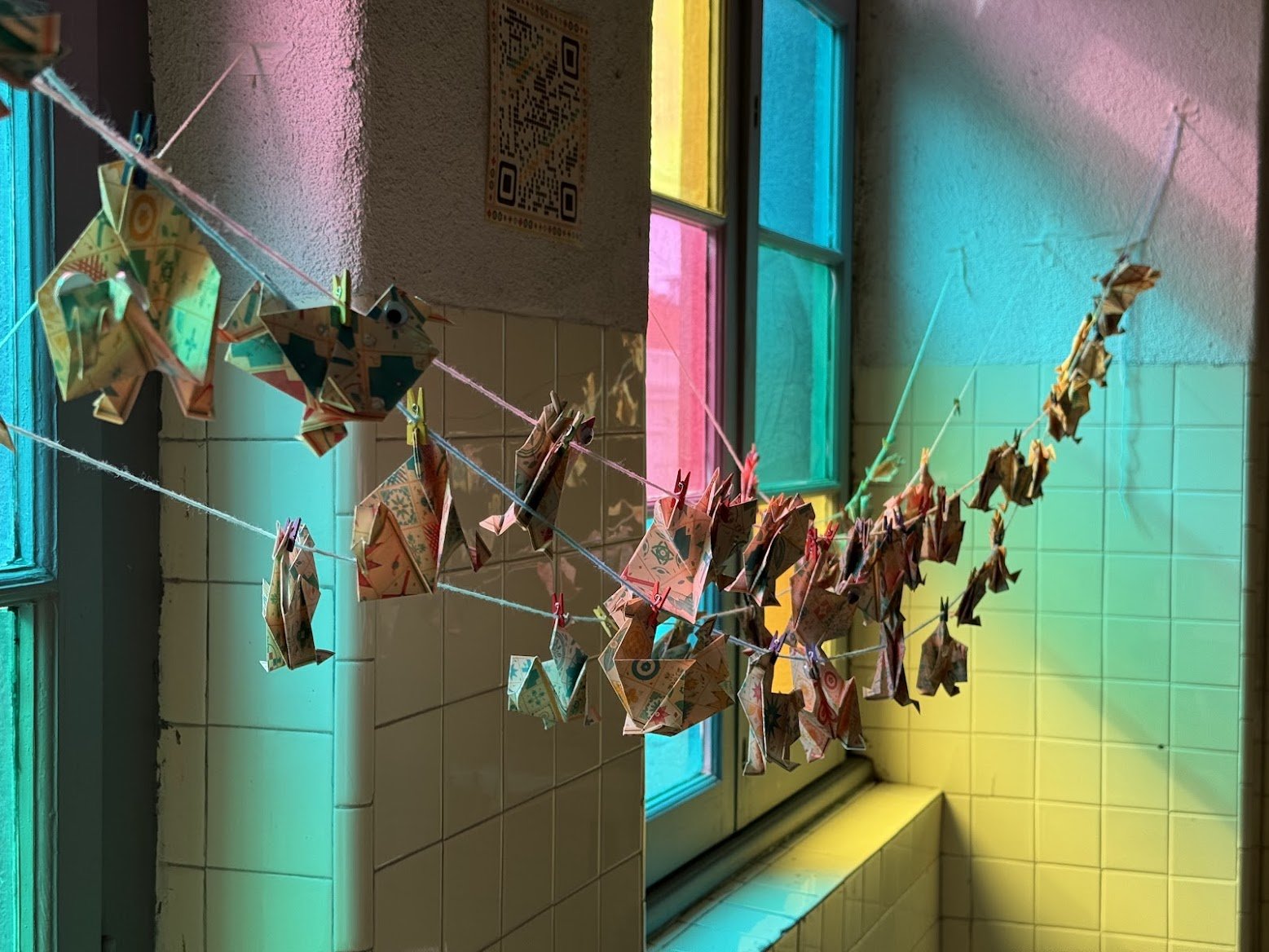
In June 2026, in a former flour factory in Lisbon, Bryan Brinkman sat at a booth folding paper. Collectors booked fifteen-minute appointments to sit with him. Each sitting followed the same liturgy: mint a token, print the composition it generated, and fold it, together with the artist, into an origami rooster. The finished birds went up on strings above the booth, a flock accumulating over three days of NFC Summit. Every collector who sat with him also left with a second rooster, folded by Brinkman himself, a keepsake of the encounter.
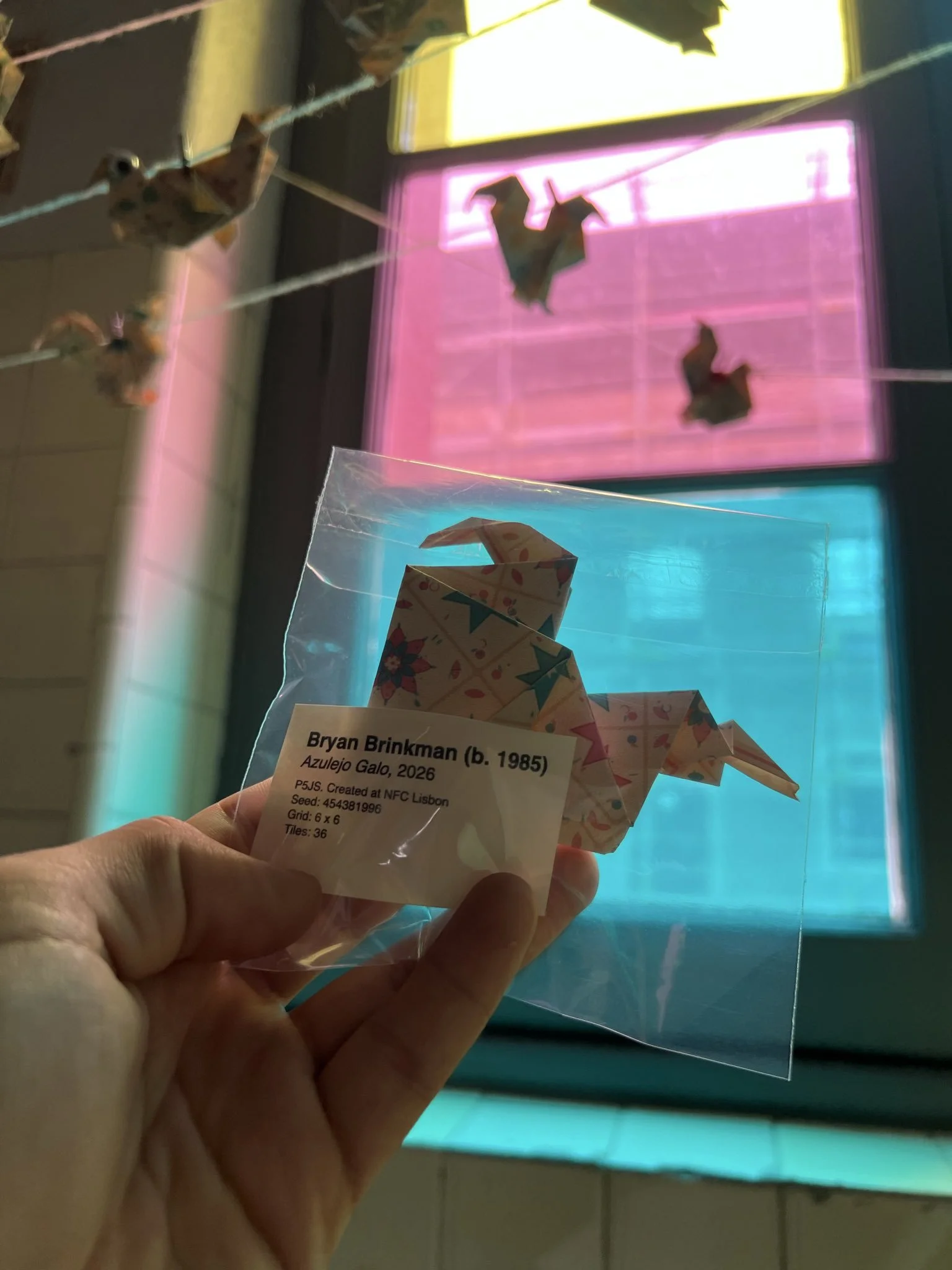
The project, Azulejo Galo, is a 250-piece generative series that borrows two of Portugal's most saturated visual signs: the blue-and-white azulejo tile and the Galo de Barcelos, the folk rooster of luck whose legend involves a roasted bird crowing from a judge's table to prove a condemned man's innocence. Each output is a unique tile composition that doubles as a crease pattern. Print it on letter paper, follow the folds, and the flat image collapses into sculpture.
It would be easy to read this as charm, and it is charming. But Azulejo Galo is also a compact essay on how images travel. The azulejo itself is a migrant form: the word derives from the Arabic al-zulayj, the glazed tilework of the Islamic Mediterranean, and the blue-and-white palette Lisbon now claims as its own arrived via Chinese export porcelain, filtered through Delftware, before Portuguese workshops naturalised it in the eighteenth century, cladding the city rebuilt after the 1755 earthquake. Brinkman folds this already layered tradition through a Japanese paper craft and an Ethereum smart contract, and the result reads not as pastiche but as one more link in a chain of transmission that is centuries old. Cultural forms have always been generative systems, endlessly recombined within constraints. Brinkman just made the constraint executable.
This is the mature statement of an artist who has spent six years building a visual language precise enough to absorb almost anything: a Portuguese folk symbol, a Norman Rockwell sketch, an error message, a cloud. To understand how a former late-night television animator arrived at a Lisbon flour factory with a stack of printer paper, you have to go back to the moment he decided what his colors would mean.
II. Broadcast school
Brinkman (b. 1985, Omaha, Nebraska) came to fine art through the trade entrance, which in the long history of American image-making is less an anomaly than a lineage. He studied animation at the University of the Arts in Philadelphia, then spent fifteen years in advertising and television: fashion work, HBO, MTV, Comedy Central, The Life and Times of Tim, Girl Code, and long tenures on The Tonight Show and Saturday Night Live, where his visual effects work earned four Emmys. The broadcast years taught him rhythm, legibility, and the discipline of the loop: how to make an image land in seconds, for an audience that did not ask to see it.
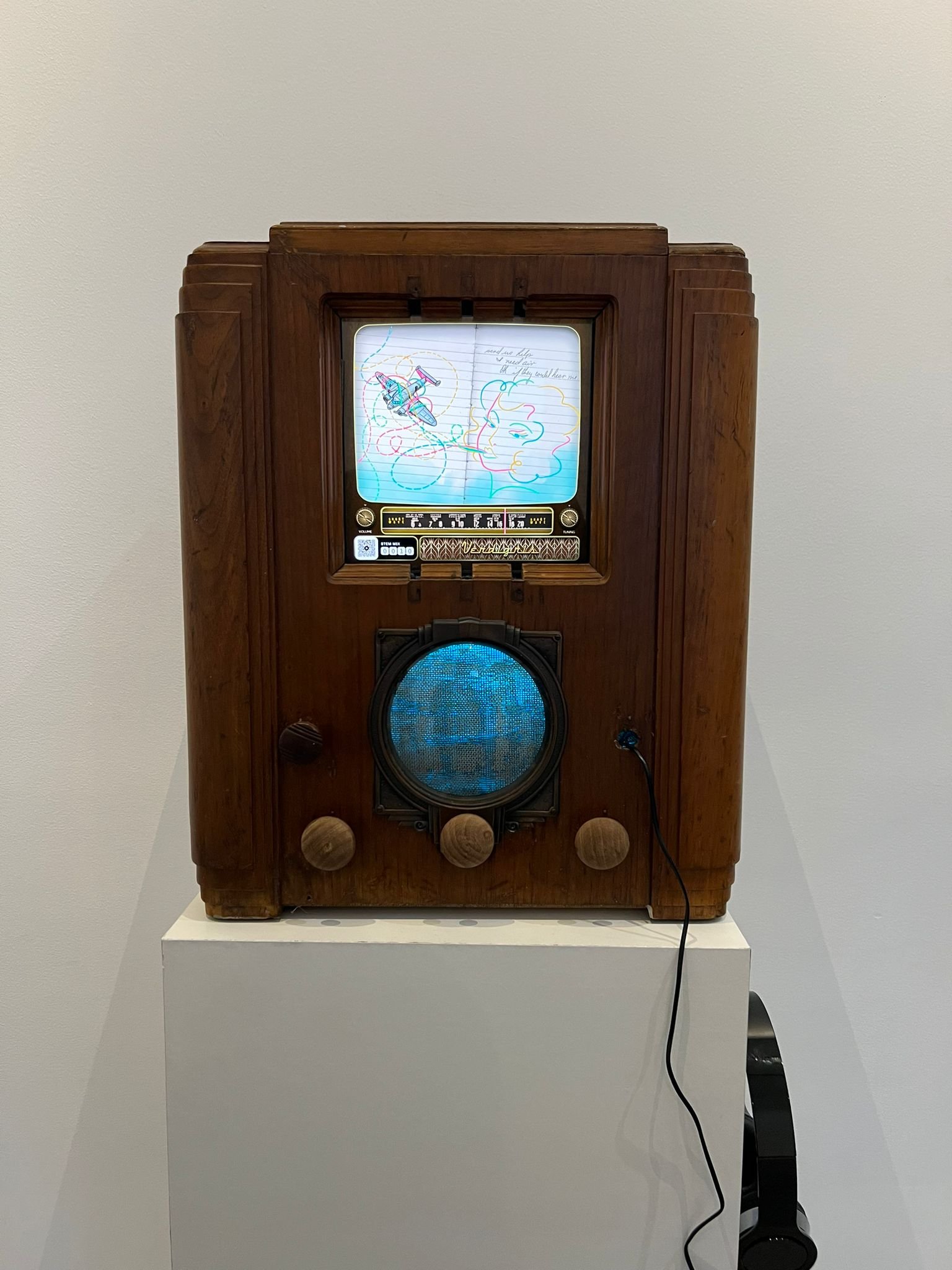
This résumé rhymes with the pre-histories of the artists he most obviously descends from. Andy Warhol drew shoes for I. Miller before he silkscreened Marilyn; Norman Rockwell spent five decades answering to the editors of the Saturday Evening Post; Nam June Paik built a fine art practice out of the very apparatus of television.
The commercial image-maker who crosses into the gallery brings something the gallery-trained artist rarely has: an unembarrassed fluency in mass address, and a working knowledge of what images do when money is attached to them. Brinkman cites Keith Haring as a model precisely for this reason, an artist who rode the line between pop and commerce without surrendering his integrity, and he credits independent animators like Don Hertzfeldt and Bill Plympton with the lesson that you did not need to draw like Disney to make people feel something.
In December 2019 he encountered the work of Killer Acid on SuperRare and understood, quickly, what tokenisation meant for someone in his position. He had spent years translating digital work into physical objects in order to make it saleable at all. Here was a mechanism that let animation, his native medium, be collected as itself. He applied to the platform the next month.
Animation, after a century as the most industrialised and least collectible of art forms, had acquired a unit of account.
III. Explode, and the invention of a syntax

Brinkman minted his first piece, Explode, on SuperRare in February 2020: a short looping animation of candy-colored clouds erupting like popcorn. The choice of register was deliberate and, in context, contrarian. Crypto art in early 2020 skewed glitchy, grimy, dark, he recalls; the platform's aesthetic default was dystopian, and there was little animation and less color. His first five pieces were an exercise in finding footing inside that environment. The third, he tells me, was a throwaway he rebuilt as a gif riffing on The Evil Dead, an early instance of a habit that would become structural: reimagining past work rather than abandoning it, treating his own back catalogue as raidable material the way Pop treated the comic strip and the soup can.
Then came the decision that organised everything after. Rather than let a style emerge and recognise it retroactively, Brinkman built the system first. The neon-pastel palette of Explode became a deliberate protocol: if every work drew from those colors, he realised, he could move through any medium or style and, as he puts it, "it all ties together." The iconography followed the same logic. The clouds of that first explosion came to stand for the cloud on which all this art is stored; the wires that thread through his compositions figure the connections between people on the network. What looks like whimsy is closer to a controlled vocabulary.
Art history offers several precedents for this kind of self-imposed syntax. Roy Lichtenstein's Ben-Day dot was not a style but a system, a mechanical grammar that let him process war comics, Picassos, and mirrors through a single legible filter. Haring built a lexicon of glyphs, the radiant baby, the barking dog, that could scale from subway drawing to mural to merchandise without loss of identity. Takashi Murakami formalised the same move as Superflat, a trademark visual field flat enough to hold both luxury commerce and postwar trauma. Brinkman belongs to this family of artists for whom coherence is engineered rather than found, and his background makes the engineering unsurprising: a motion designer's first professional instinct is the style frame, the specification that guarantees a hundred artists can produce one coherent broadcast.
There is also a biographical hinge here that deserves attention, because it inverts the usual story of the market constraining the artist. Before NFTs, Brinkman had shown a body of work at a Los Angeles gallery. The curator offered him another exhibition on one condition: maintain the style. Keep making the thing that sold. The crypto space, he says, functioned as a reset, an escape hatch from precisely that trap. The irony is exquisite. He fled a gallery's demand for consistency and immediately imposed a far stricter consistency on himself, but with the terms reversed. The gallery wanted a repeatable product; Brinkman built a repeatable language. The distinction matters. A product constrains what you make. A language constrains only how it looks while freeing what it can say, which is how a single palette has since carried him through one-of-one animation, generative art (his Art Blocks Curated debut Nimbuds, built with the coder Manny Morales in January 2021, reworked the clouds and neons of the SuperRare pieces into an autonomous system), programmable music (Betty's Notebook, with Async), open editions, physical prints, and now folded paper.
He committed to the discipline with broadcast-schedule stamina: one piece a week, for nine months, working through the compressed art history of a market inventing itself in real time. Underneath the output ran a conviction he articulated early in his crypto writing, that these systems were now where value would be locked up, that the ledger was not a gimmick attached to the art but the new institutional substrate the art would live inside. It was a claim about infrastructure, and he made it before the institutions agreed.
IV. The candy coating
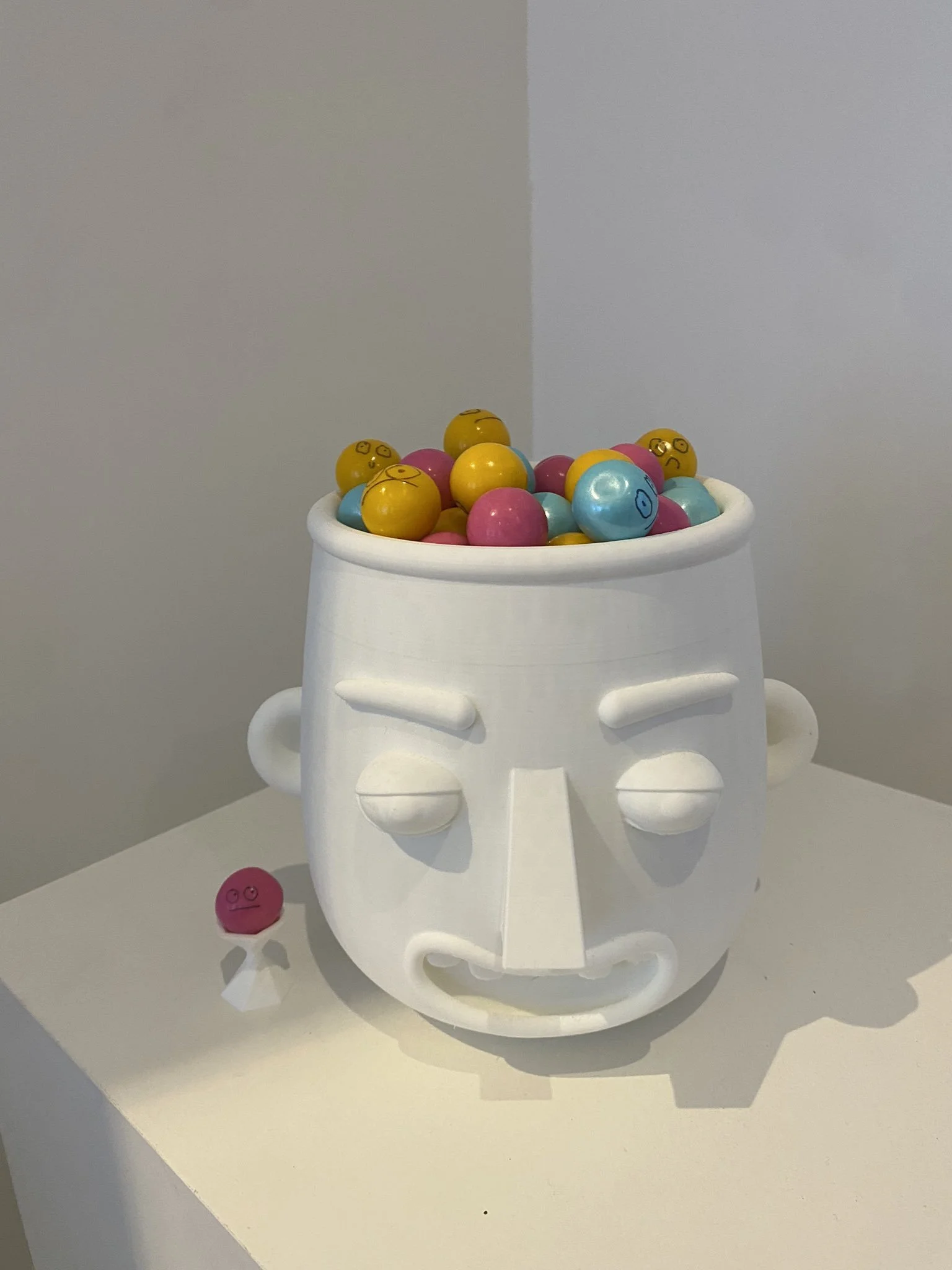
The most quoted sentence Brinkman has given an interviewer came in conversation with Anna Seaman: he uses, in his phrase, a "candy coating of colour" to draw people in before telling them what he actually thinks. It is worth taking the confection metaphor seriously, because the sweetened surface with a bitter center is one of the great strategies of postwar art, and Brinkman deploys it knowingly.
When I put it to him directly, whether the tension between the work's warm, legible, even cute surface and his evidently more critical relationship to the space is intentional, his answer was unhesitating: yes. The work is built to be read at two speeds. You can enjoy it for its cuteness, full stop, and that reading is not wrong, merely partial. Or you can stay long enough for the complexities and the hidden undertones to resolve. The pieces are engineered for both audiences simultaneously, the way a Pixar film carries one script for children and another for the adults who brought them.
The theoretical literature on cuteness suggests why this double address is so effective. Sianne Ngai has argued that cute is the aesthetic category proper to the commodity, an appearance of softness and powerlessness that solicits handling, consumption, possession. Cuteness disarms; that is its function. An artwork that weaponises cuteness therefore smuggles its critique inside the very affect that makes viewers lower their guard. Murakami's Little Boy project made the canonical case, reading Japan's kawaii culture as the sugared crust over the trauma of Hiroshima. Félix González-Torres literalised the candy: his spills of wrapped sweets, free for the taking, endlessly replenished, folded grief, generosity, and the erosion of a body into the most inviting object imaginable. Brinkman's confections operate in this tradition at a different temperature. Swing, a caricature self-portrait rocking on colored strings, is child's play until you notice the precarity of the rigging, at which point it becomes a diagram of an artist suspended inside a volatile market. CTRL addressed the ways collectors exert control over artists; Wired, the isolation of a life lived through screens. The vast majority of his art, he has said flatly, is not happy. The colors just make it look that way, and that is the plan.
What separates this from cynicism is that the coating is not a lie. Brinkman evidently loves the colors; the pleasure is sincere, which is what allows the criticism to be sincere too. The proper comparison is not the troll but the court jester, or the late-night writers' rooms he spent years creating for, where the joke is the delivery mechanism for the thing that could not otherwise be said on air.
V. The rooms upstairs
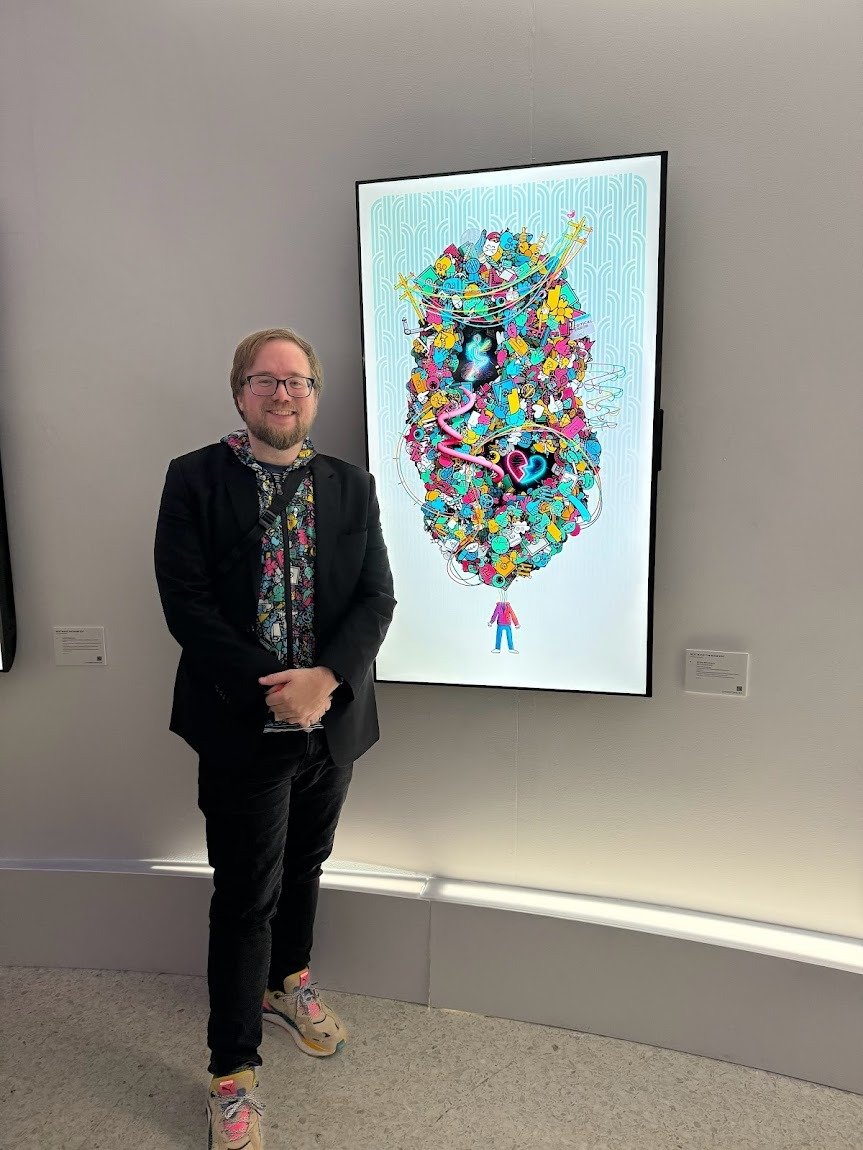
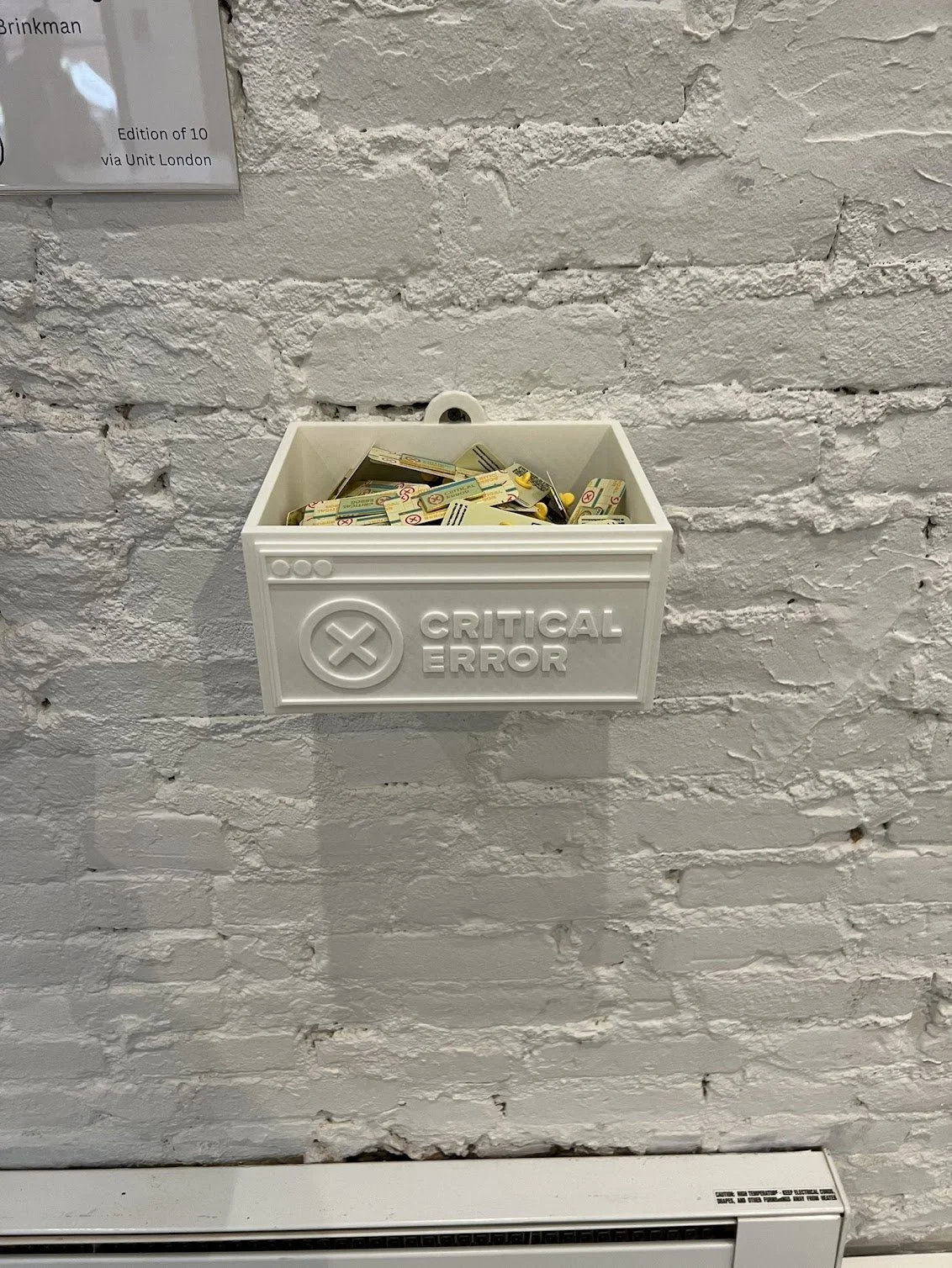
Brinkman's institutional arc has been swift by any standard: presentations at Christie's and Sotheby's (Explode itself sold at Sotheby's in October 2021, to the collector Pranksy, for $75,600), gallery exhibitions at Saatchi Gallery in London, Unit London, and SuperRare Gallery in New York, and a collaboration, through Iconic, with the Norman Rockwell Museum and the Rockwell family.
When I asked whether moving through those rooms changed how he makes the work, or who he imagines it is for, his answer was a flat no, with a caveat: they motivated him. This is a more interesting answer than it first appears. The standard narratives of the outsider entering the institution run in two directions, assimilation (the work smooths itself to fit the room) or refusal (the work performs its outsiderness for the room's benefit). Brinkman claims neither. The system he built in 2020 was designed to be venue-independent, the same syntax whether the output is a phone-sized gif or an auction lot, and the institutional validation functions as fuel rather than steering.
The Rockwell project, Ephemeral Embers (2024), is the richest of these institutional encounters, because Rockwell is himself the great test case of the illustration-versus-art border that Brinkman's whole career interrogates. Rockwell was condescended to for decades by a critical establishment that could not forgive his popularity or his commercial patronage, and was only seriously rehabilitated within living memory. For the collaboration, Brinkman studied the museum's collection and chose not a finished Post cover but an ink sketch, a raw, uncharacteristically vulnerable piece of process material, and built his animation around it, framing the work explicitly as a meeting of two artists in the shared space of ideation.
The choice is telling: what interested him was not Rockwell the icon, but Rockwell the working image-maker, the man with deadlines. One hundred digital editions were paired with one hundred unique prints, each capturing a different frame of the animation, signed and numbered.
The frame-as-edition device, which he had already used at Unit London, is a quiet conceptual joke worthy of the medium: an animation is a sequence of stills, so the physical edition simply de-animates the work, distributing time itself across a collector base.
Walter Benjamin haunts all of this, as he haunts every serious conversation about digital art. Benjamin argued that mechanical reproduction withers the aura of the artwork, the authority of its unique existence in one place. The token was supposed to be aura's technological resurrection, uniqueness reinscribed by ledger. Brinkman's practice suggests a more supple reading: aura, in his work, does not live in the file or even in the token but in the system, the provenance, the accumulated context, and, increasingly, in the fifteen minutes a collector spends folding paper across a table from him.
VI. Memory, error, and the pharmakon
If the candy coating is Brinkman's strategy, memory is his subject, and nowhere more explicitly than in the 2023 body of work he presented with Unit London. Memory Loss, Dead Man Walking, and De-fragmented mark the point where the conceptual undertow of the practice surfaces and holds.
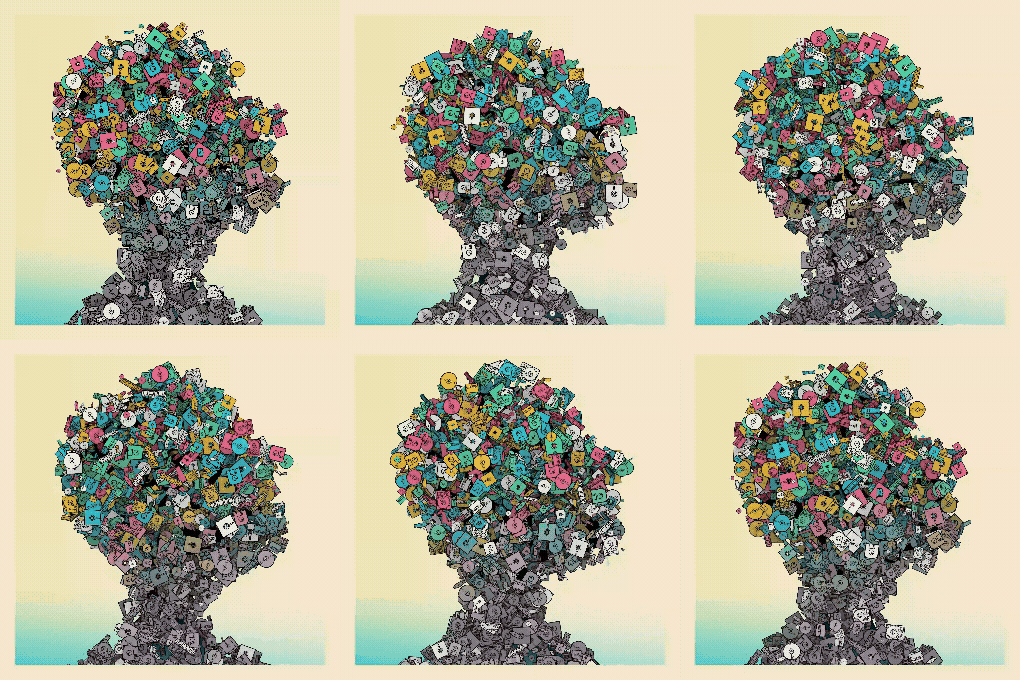
Memory Loss animates symbols of digital storage effervescing in the silhouette of a face, setting the ephemerality of human memory against the supposed permanence of the machine. Its origin is disarmingly personal. One of Brinkman's earliest digital creations was a custom video game map, a crude walkable recreation of his childhood home, built when he was a teenager learning his tools. The house has since been sold and changed; his memories of it have faded and drifted. But the .map file survives, carried from hard drive to hard drive for more than twenty years, and loading it transports him back with a fidelity his own mind can no longer supply. Dead Man Walking inverts the consolation: a figure composed of critical-error messages walks toward the viewer, or perhaps away, a rumination on what happens to identities entrusted to systems when the systems fail. De-fragmented, named for the obsolete ritual of rearranging scattered data on a hard drive, watches an introspective figure reassemble himself one pixel at a time, and asks how differently, really, brains and machines process their fragments.
When I asked whether this series felt like a departure or whether it was always underneath the playfulness, his answer was that it was always there, with nuances. The record supports him. The clouds were storage from the beginning; the wires were always about connection and its failures. What changed at Unit London was not the content but the explicitness, the willingness to let the coating thin.

The philosophical frame these works reach for is ancient.
In Plato's Phaedrus, the king Thamus rejects the god Theuth's gift of writing with the argument that it will produce forgetting, an external memory that atrophies the internal one; writing is a pharmakon, at once remedy and poison. Every memory technology since has restaged that ambivalence, and Brinkman's series is a restaging for the age of the cloud. Bernard Stiegler, the great contemporary philosopher of this problem, called such externalised memory tertiary retention, the technical prostheses (the book, the photograph, the hard drive, the chain) through which human memory has always already been outsourced, and argued that we are constituted by our technics as much as we constitute them. Brinkman's .map file is tertiary retention in its purest form: the memory is not in him anymore, it is in the file, and he visits it. Memory Loss simply asks the viewer which of their own selves currently lives on someone else's server. Henri Bergson would add the darker note that memory is not storage at all but duration, something lived rather than retrieved, which is precisely what the file cannot give back, and what Dead Man Walking's error-riddled figure mourns.
Brinkman's own gloss on the series, offered at the time, was that the collection embodied a Web3 ethos because "the artwork is talking about its own existence": work about technology, made of technology, stored in the thing it depicts. It is a McLuhanite closed loop, medium and message collapsed, and it clarifies what distinguishes his conceptual work from the vast genre of art that merely illustrates ideas about the digital. The clouds in Memory Loss are not pictures of the cloud. They are in it.
VII. The fold
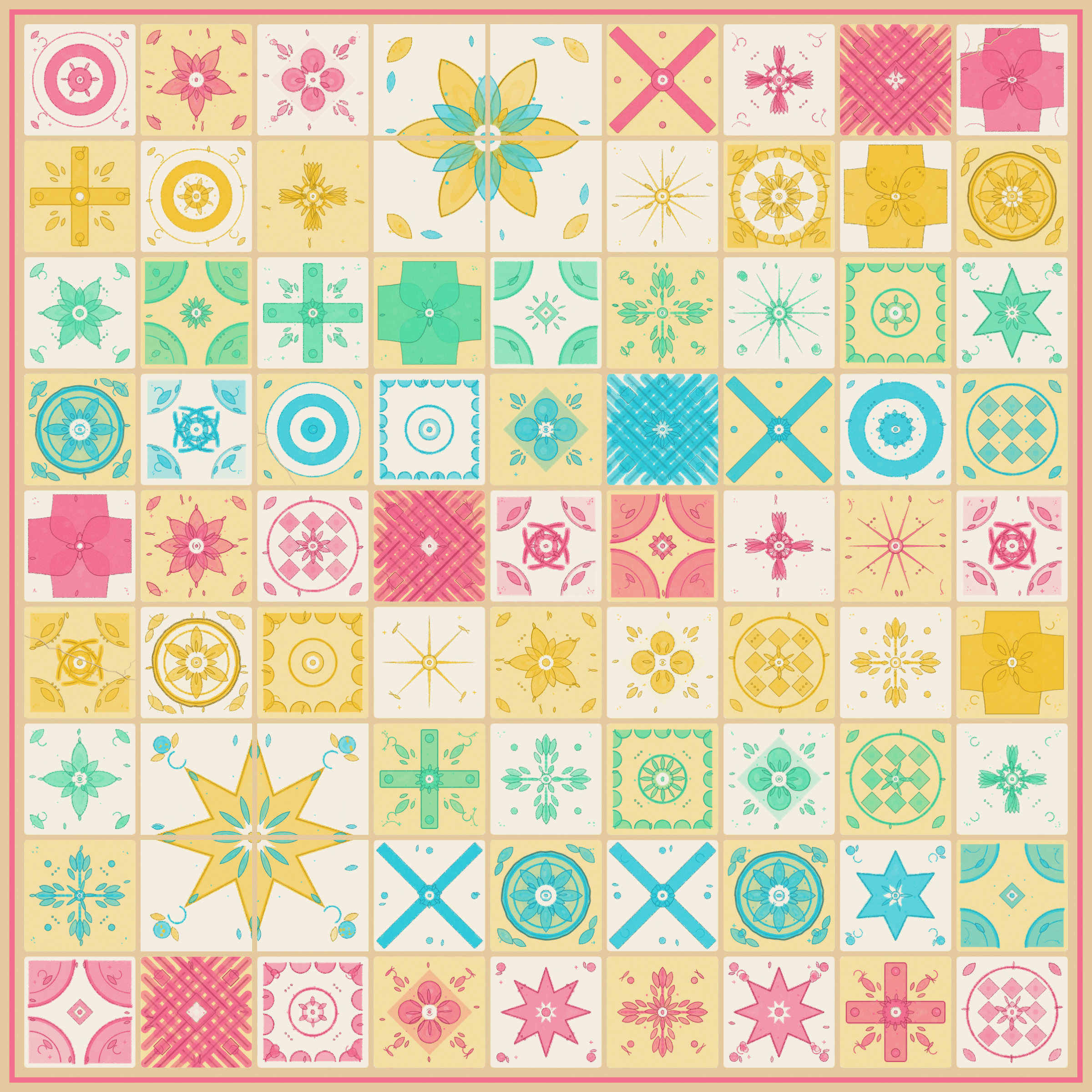
Which returns us to Lisbon, and to why Azulejo Galo feels like a hinge rather than a side project.
Everything the practice had separately developed converges in it. The controlled palette meets a historical palette (azulejo blue-and-white is itself a controlled vocabulary, four centuries old). The generative system meets folk narrative, the Barcelos legend supplying the kind of pre-modern provenance story, an artwork testifying to truth, that blockchain culture keeps trying to reinvent. The frame-as-print logic of the Unit London and Rockwell editions matures into something better: the print is no longer a memento of the digital work but its instruction set, and the collector's labor completes the piece. Marcel Duchamp said the viewer completes the work of art; Brinkman hands the viewer a crease pattern and makes it literal.
The IRL structure deserves its own reading. Seventy-five of the 250 mints were reserved for those booked sittings; the rest rolled out through allowlist and public tiers over the summit weekend. The sittings, the shared folding, the flock of birds accumulating overhead as a public record of encounters, place the project squarely in the territory Nicolas Bourriaud named relational aesthetics, art whose medium is the social situation it convenes. But the second rooster, the one Brinkman folds himself and gives away, reaches further back, to Marcel Mauss and the anthropology of the gift: the object that binds giver and receiver, that cannot be fully priced because it carries the person of the maker in it. In a market that spent its first years pathologically obsessed with floor prices, an artist folding an unpriceable second bird for each collector is not a flourish. It is an argument.
And the argument is consistent with the one he has been making since February 2020. Value, he understood early, was going to be locked in these systems. The mature work asks what kind of value, and answers by multiplying its forms: the token, the print, the fold, the fifteen minutes, the memory of the fifteen minutes, which will fade, and the birds on the string, which will not. His website, notably, is built the same way, less a portfolio than a living document organised around the collector's experience, catalogue, provenance, registry, an artist constructing his own institutional memory rather than waiting for an institution to do it.
Aby Warburg built his Mnemosyne Atlas to trace how images survive their moments and migrate across centuries. Brinkman, an animator from Omaha by way of Studio 8H, is building his atlas in public, in neon, one folded rooster at a time.
The candy gets you in the door. The wires are what the whole thing hangs on.
Bryan Brinkman (b. 1985) lives and works in New York. Azulejo Galo debuted at NFC Summit, Lisbon, June 2026.