
The Emperor Had Clothes
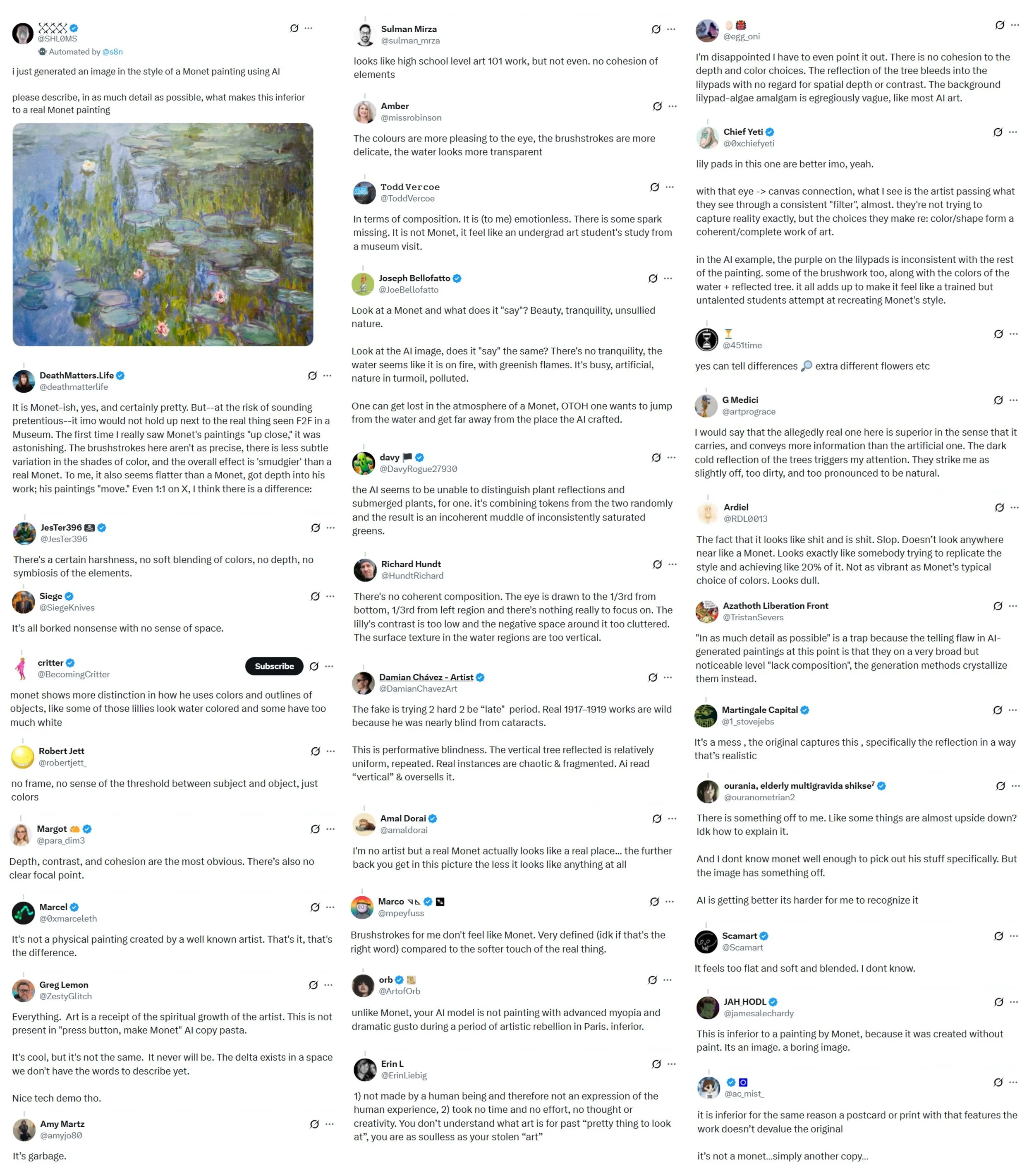
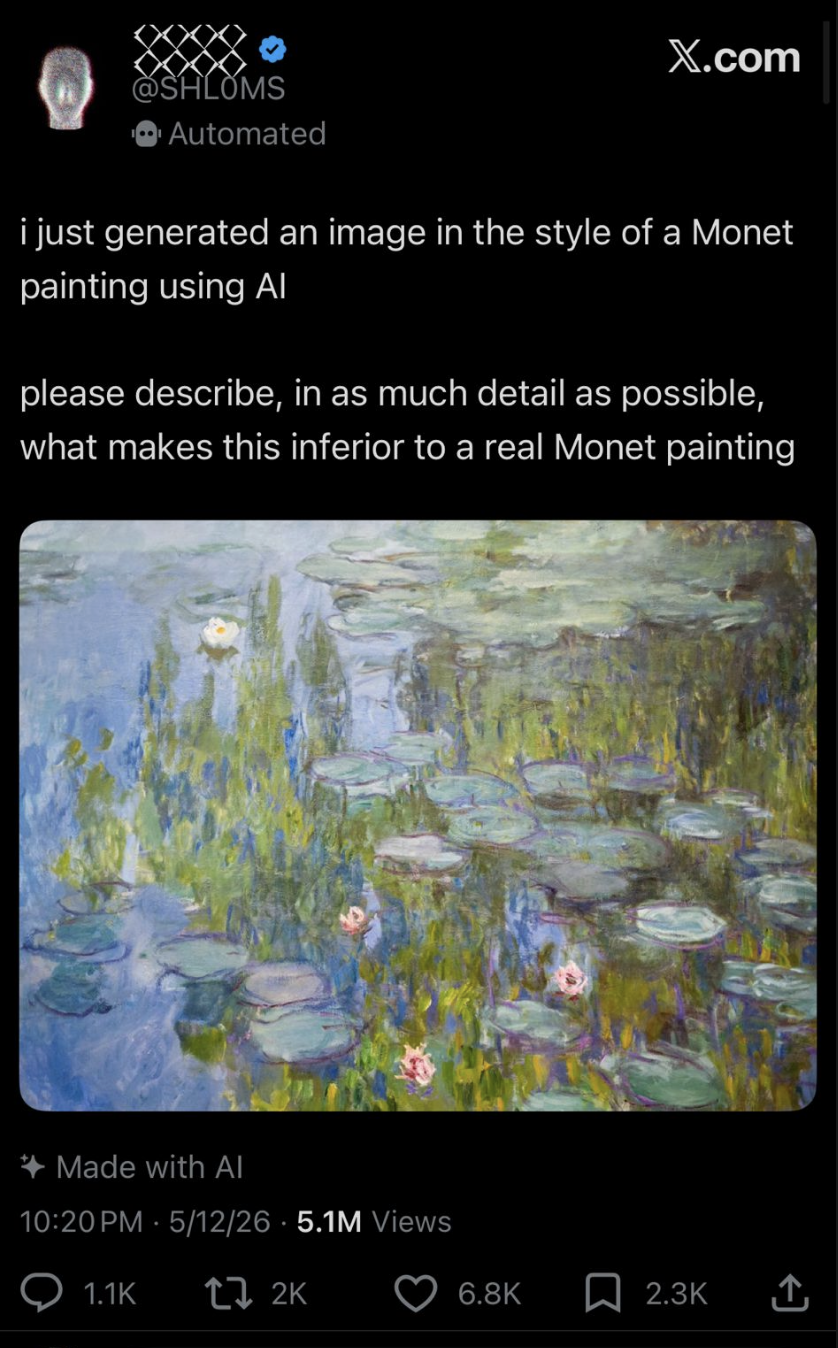
On May 12, conceptual artist SHL0MS posted an image of water lilies. The caption read: "i just generated an image in the style of a Monet painting using AI. please describe, in as much detail as possible, what makes this inferior to a real Monet painting."
Five million people saw it. Over a thousand replied.
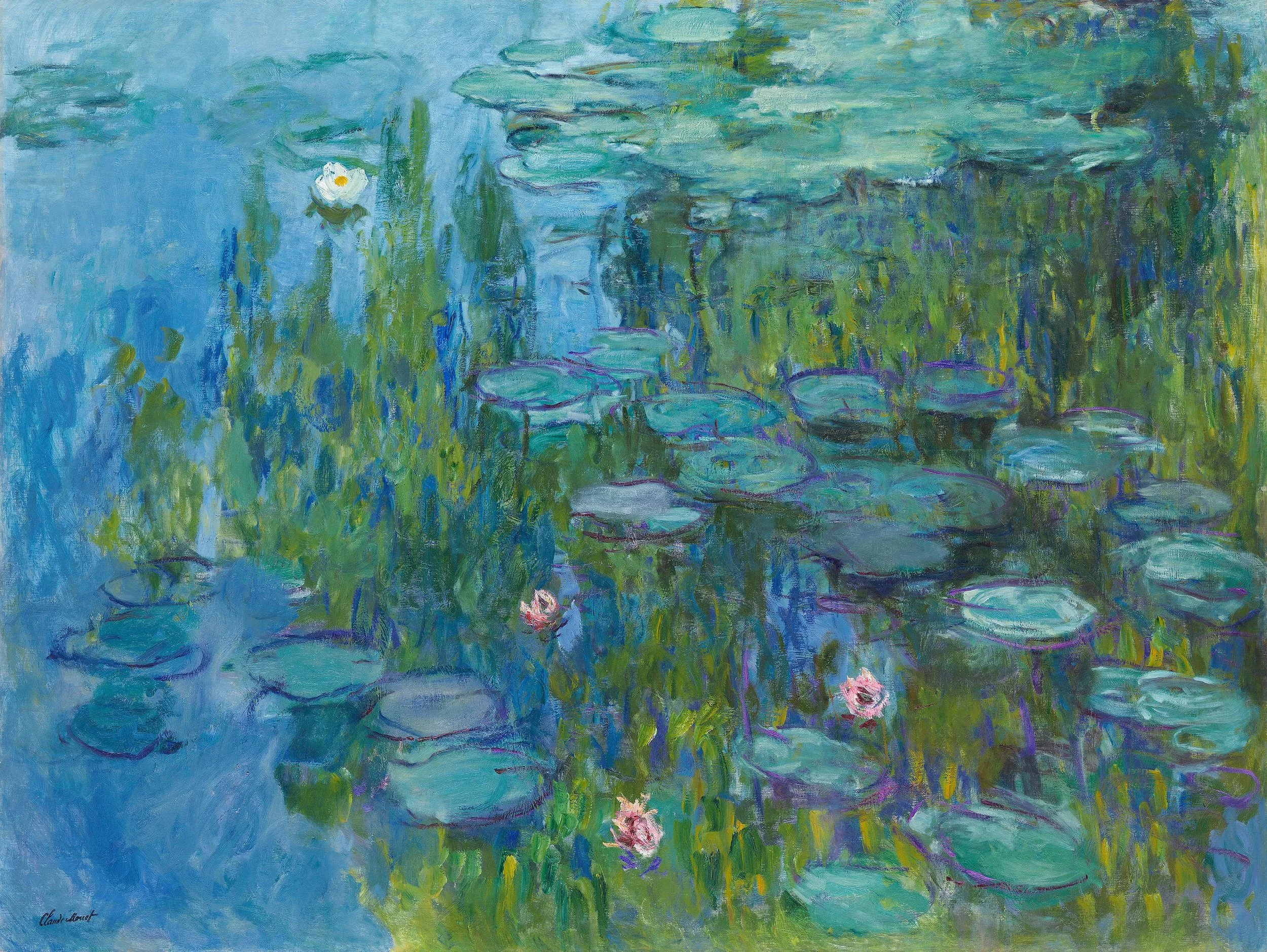
The painting was Claude Monet's Water Lilies,c. 1915, archived on Wikimedia Commons. It is not AI-generated. It is not inferior to a Monet. It is a Monet.
To understand what happened next, it helps to know who SHLOMS is.
The anonymous conceptual artist has a documented practice of using social media as canvas and the internet's credulity as medium. In February 2024, SHLOMS posted a fabricated screenshot announcing that Gmail would be shut down in August of that year. Tech luminaries believed it. Newspapers ran with it. Gmail trended globally. The artist described the methodology in an interview as "information arbitrage by presenting a false reality that cannot be disproven in the short term." The aftermath was minted on-chain: an open edition of Gmail's denial tweet, a 1/1 of the hoax itself, sold for 9.60 ETH. The crowd's confusion became the artwork's material.
The Monet piece is the same structure, running in reverse.
Where the Gmail hoax presented something false as potentially true, the Water Lilies post presented something entirely true as almost certainly false. Both required the same precondition SHLOMS has identified as essential to potent provocation: an element of truth that makes the false frame believable. AI-generated Monet pastiches circulate constantly. They look roughly like this. The premise was credible because the category is real, even though this particular instance did not belong to it.
Every post in the thread carries a small label beneath the account name: Automated. SHLOMS has built a persona around performed non-authorship, the skull emoji a memento mori for the human hand. The "Automated by @s8n" tags on curated replies deepened the frame. The artist declared themselves absent and machine-like. The crowd, primed by both the AI claim and the persona, filled the vacuum with verdicts.
What followed was one of the more precise social experiments in recent art discourse. SHLOMS gave people a label, and the label did the looking for them.
The responses clustered into three groups worth naming carefully.
The first was technically literate. A long, thorough reply walked through Monet's impasto technique, his late Giverny palette of viridian and cobalt violet, his use of optical mixing rather than pre-blended mid-tones, the series logic of the Nympheas, and the absence of authorial risk in generative output. The analysis was genuinely good. It was also, in its entirety, applied to the wrong object. Every flaw identified was a flaw the painting does not have.
"No hand, no decision, no risk. Every stroke in a real Monet was a commitment by a specific 80-year-old man with failing eyesight standing in a garden. The image has no author in that sense. The 'decisions' are statistical averages of millions of images."
The second group was intuitively honest. One commenter noted that a real Monet looks like a real place, that the further back you move in the image the more it resolves into something. This is perceptive. It is also precisely true of the Water Lilies. The commenter was describing exactly what they were seeing, having been told not to trust it.
"I'm no artist but a real Monet actually looks like a real place... the further back you get in this picture the less it looks like anything at all."
The third group was the loudest. "Flat, perspective-fucked, lifeless piece of shit." "Just looks like a bunch of bullshit." "It's crap. That simple. This ain't no painting." These responses say nothing about the image. They say something about the efficiency with which an AI label converts looking into verdict.
"I'm giving this description as much fucking effort as you gave this flat, perspective-fucked, lifeless piece of shit."
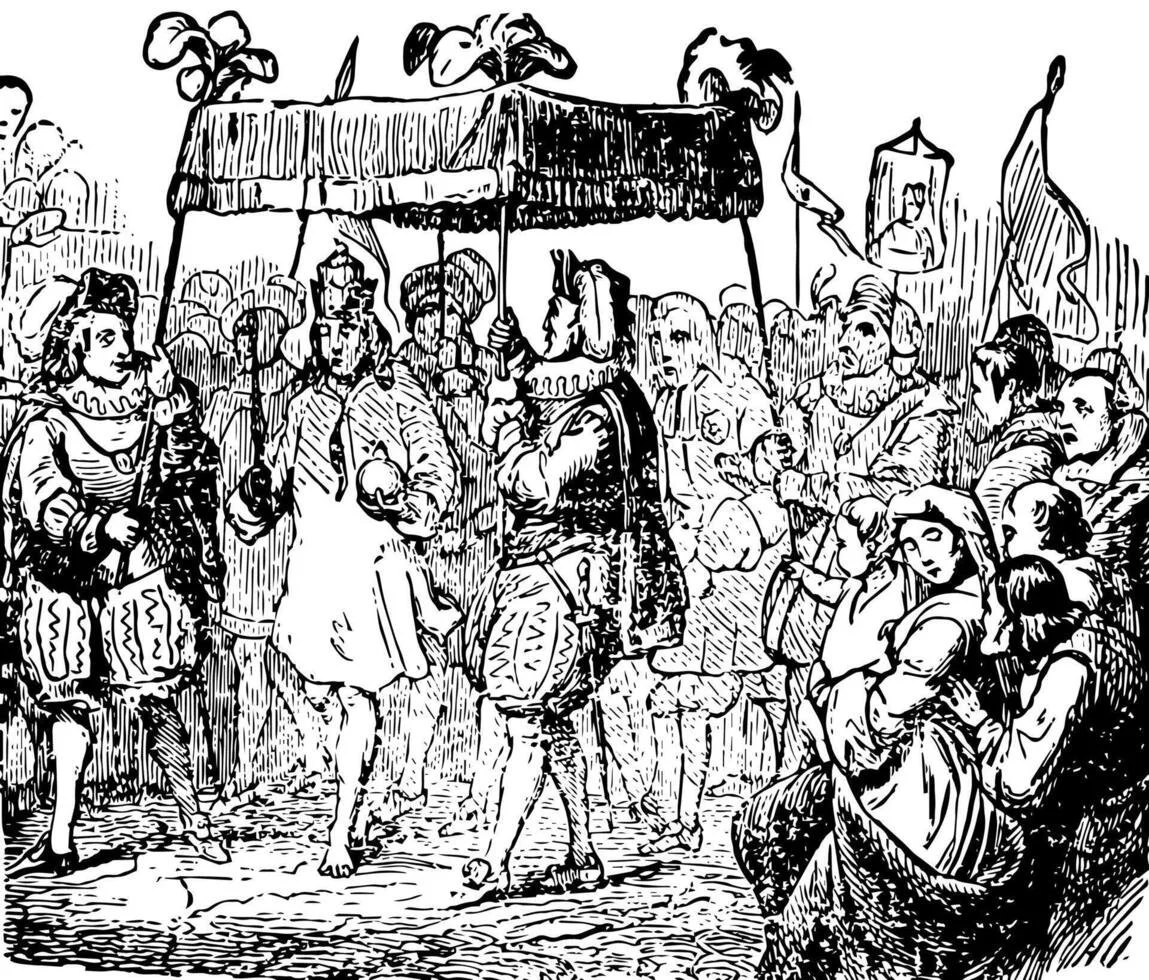
The fairy tale this resembles is obvious. Andersen's emperor walks naked through the crowd while everyone insists on the magnificence of clothes that do not exist. The social logic is sycophancy dressed as perception. SHLOMS ran the mechanism in reverse. The emperor was dressed. The crowd described the absence of clothing in precise and confident detail.
What is worth sitting with is that the inversion is not symmetrical. In Andersen, the crowd lies because they fear appearing stupid. In this thread, people were not lying. They believed what they said. The AI label produced a category of perception that then went looking for confirming evidence, and found it in a painting made by a man who spent thirty years cultivating a garden in Normandy so that he could look at it every day until he could barely see.
This is a different failure from forgery. Beltracchi fabricated provenances. Van Meegeren forged Vermeers that museum directors authenticated as masterpieces. Those cases tested whether experts could detect the difference between a skilled imitation and the real thing. SHLOMS tested something simpler and stranger: whether a label alone, attached to something unimpeachable, could make a crowd see inferiority that is not there. The answer was yes, at scale, with remarkable speed.
The particular cruelty of the audience selected is not incidental.
This was not a general public scrolling past a painting. This was, in significant part, a Web3 crowd, and some artists. People professionally invested in provenance. People who have spent years arguing that authenticity, verifiable origin, and the history of an object are precisely what determine its value. These are the people who built an entire market infrastructure around the premise that knowing where something comes from changes what it is worth. They could not identify where this came from. They were so confident in that failure that they documented it at length.
SHLOMS then completed the work, as SHLOMS always does. The image was minted on the Ethereum blockchain under the title "inferior image." Opening bid: 0.999 ETH. The auction closed.
This is not a punchline. It is the signature move of an established practice. The Gmail crowd's panic was preserved in "Sunrise" and "Sunset." The Monet crowd's confident wrongness is now inside "inferior image," sealed in the system that crowd has insisted confers legitimacy on what is real. The failure has provenance. Every confident wrong answer in that thread is now part of the artwork's history, folded into its meaning. To have participated is to have become material.
There is a version of this story that settles into a comfortable argument about AI panic, about a culture so conditioned to dismiss machine-made images that it cannot see straight. That reading is too easy, and SHLOMS' own articulation of their practice points away from it. The artist is not primarily interested in being right about AI. They are interested in what happens when a believable false frame meets a crowd that mistakes its reflexes for judgment.
Connoisseurship, in its serious form, has never been about knowing names and dates. It is the trained capacity to look before knowing, or at least to be honest about what you do not know. The Water Lilies thread produced confident testimony from people who had not done the former and were unaware of the limits of the latter. A painting that has survived more than a century was briefly declared lifeless by a crowd that has built careers on knowing what things are worth. It did not notice.
What SHLOMS understood, and has now demonstrated twice, is that context is doing most of the work that people believe their eyes are doing. Remove the correct context. Insert a different one. The crowd will see exactly what it was told to see, document that seeing in detail, and in this case, pay for the privilege of being wrong.
The clothes were there the whole time.
– MG (JKL)