

Sentiment Is the Last Liquid Market
On rage quitting, guilt collecting, and what $138 million lows do to a community's critical faculties
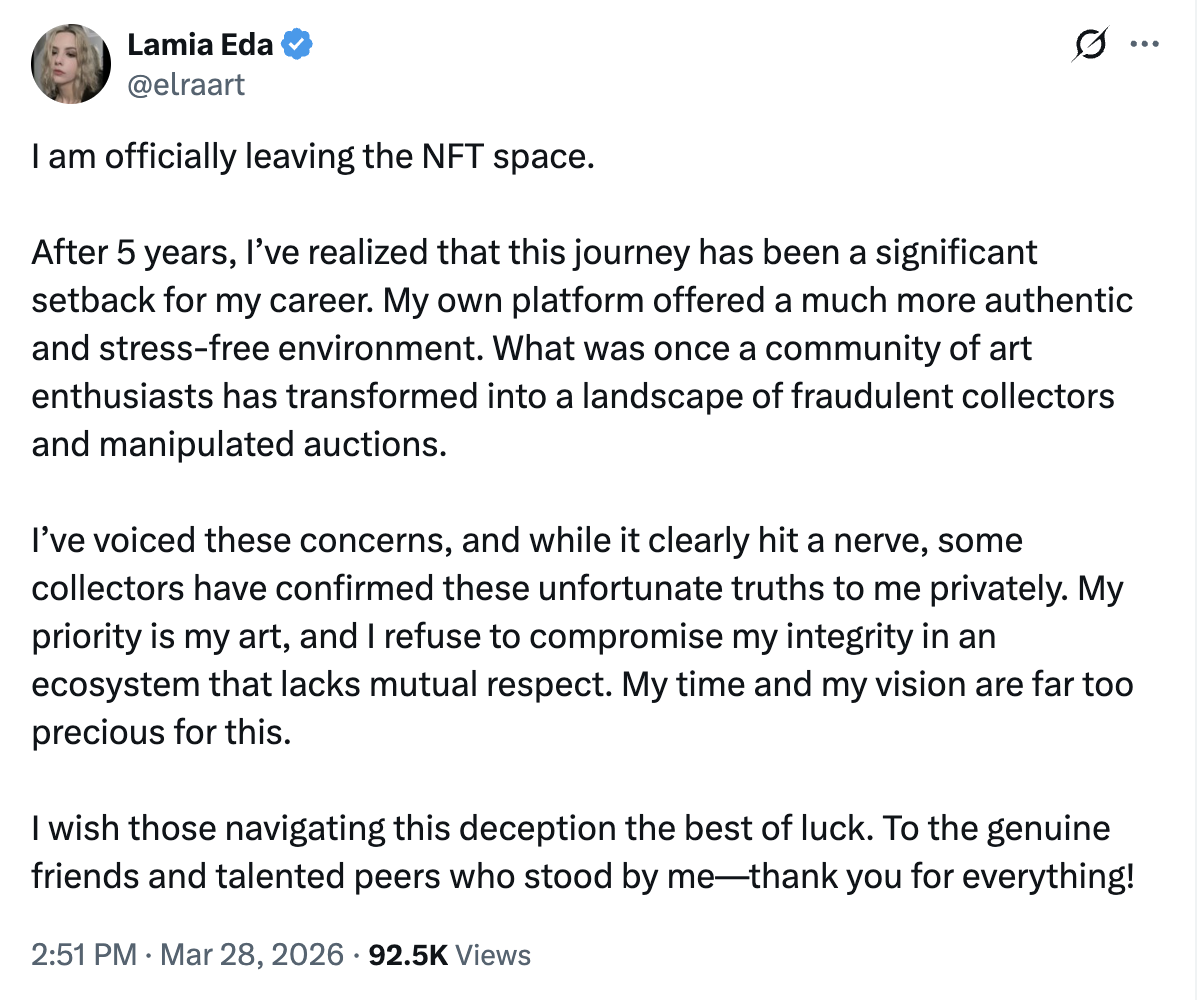
In March 2026, NFT sales hit $138 million. The lowest monthly figure since 2021. Into this climate, an artist named Lamia Eda announced she was leaving the space. The post was honest, frustrated, and recognizable to anyone who has watched talented people exhaust themselves against a market that moves on mood. Within hours, accounts with significant holdings were copy-pasting her departure text as a joke. Within a day, someone bought her work as an apology. She reposted it.
This is not a story about an artist failing. It is a story about what a depressed market does to the people inside it, and how a community that genuinely wants to do right by artists has developed, without quite noticing, a habit of converting guilt into transactions and calling those transactions support.
Let's be precise about what happened. The exit post circulated. The copy-paste meme followed, performed by people who likely thought they were being funny and did not stop to consider that publicly signaling indifference to market confidence while holding significant assets is not neutral behavior. One account observed, accurately, that this amounted to subtle sabotage at scale. The joke completed its cycle. The community felt bad. Then TheJPEGGallery purchased "The Remaining" for 0.3 ETH and posted about it, describing the purchase explicitly as personal amends. Lamia Eda reposted the announcement.
The impulse behind that purchase was not dishonest. The instinct to make something right is not nothing. But the word "amends" is worth sitting with, because amends is a moral category and collecting is supposed to be an aesthetic one. When a purchase is framed as moral repair, the work stops being evaluated as art and becomes evidence of conscience. This is not a critique of the collector's intentions. It is an observation about what the framing does to the artist's position: it makes her the recipient of a settlement rather than the subject of genuine critical attention. That is a subtler diminishment than the meme that preceded it.
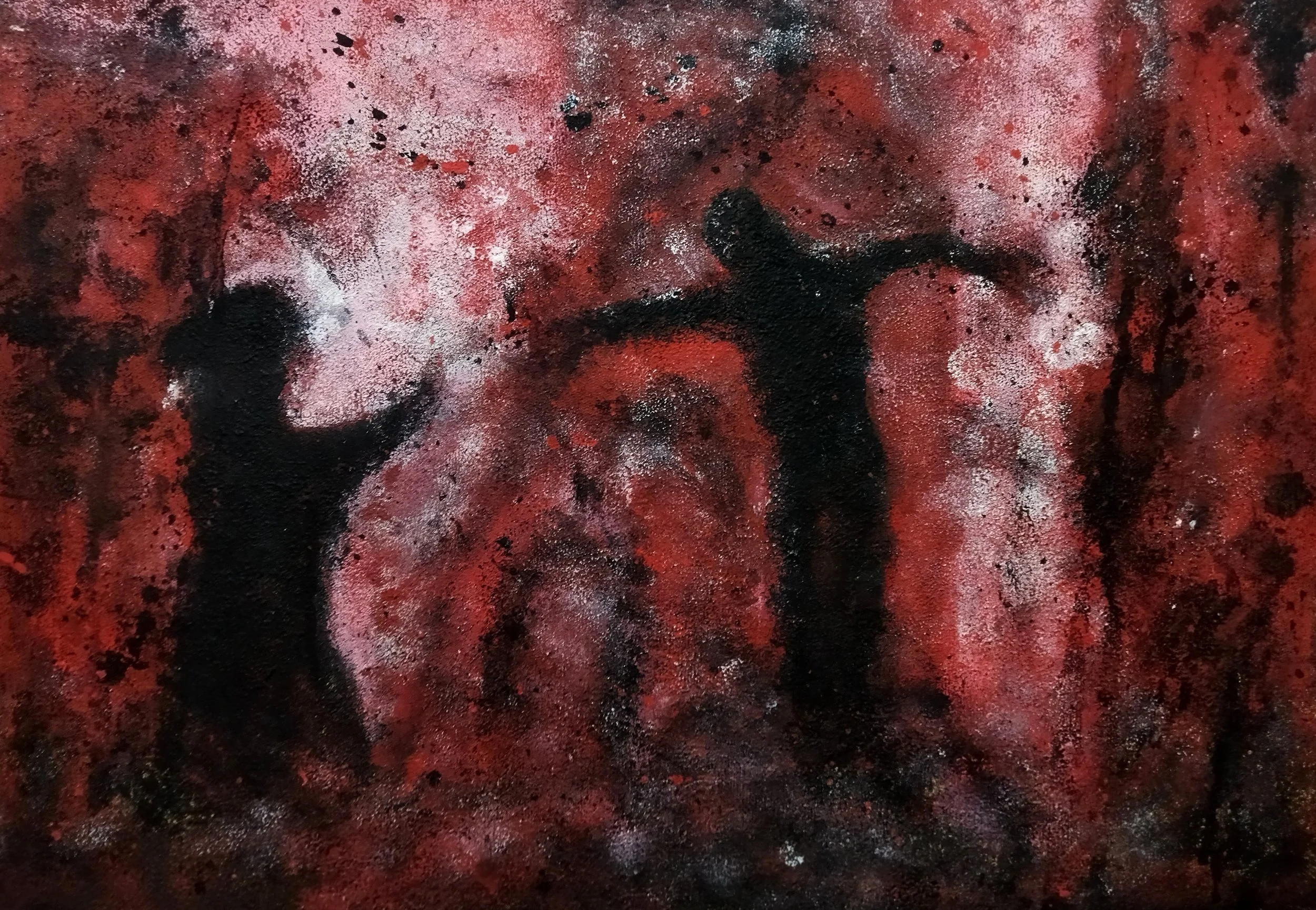
The work deserves better than either. Lamia Eda's paintings on Manifold carry a specific gravity that gets obscured by the label she has applied to them. She describes herself as a self-taught abstract artist, which in this space functions as a shorthand for authentic, unmediated, outside institutional systems. All of that may be true. But the paintings are not abstract in the formal sense, and naming them more precisely would actually serve them better. What she makes is representational work pressed toward its own erasure: figures dissolving into mineral residue, faces at the edge of illegibility, silhouettes that carry the weight of the devotional image or the damaged fresco. This is a lineage, a real and serious one, and the work belongs to it more than it belongs to the catch-all of abstraction. Giving it that address would not diminish it. It would give collectors and critics a more durable way to hold it.
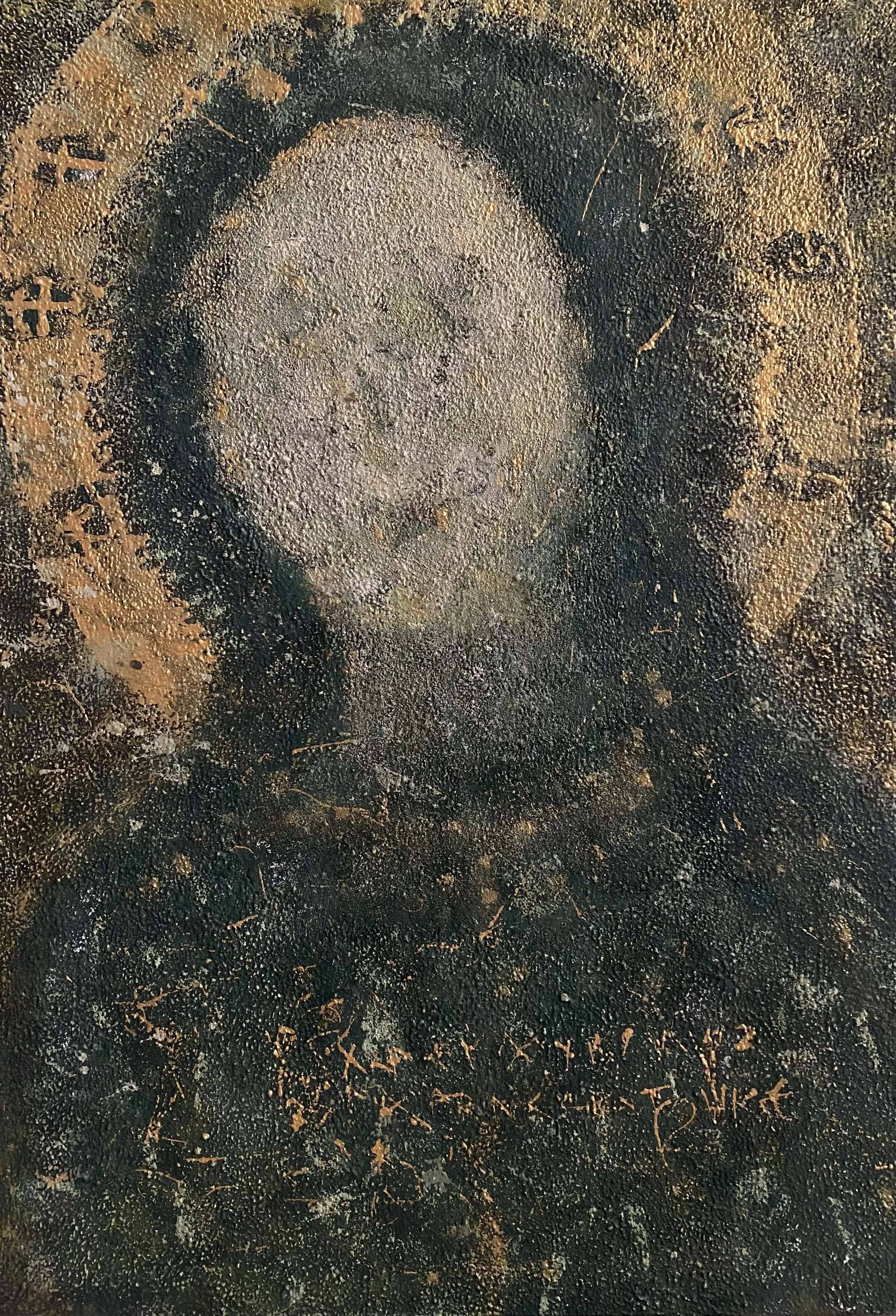
The self-taught framing compounds this, not because it is false but because it tends to close off the conversation about influence and lineage that the work actually invites. The absence of formal training is not the absence of antecedents. Acknowledging those antecedents is not a gatekeeping move. It is how work accrues meaning over time rather than in a single news cycle.
But the community never got to that conversation. Because the sequence moved too fast, from exit to meme to amends purchase to repost, for anything resembling sustained critical attention to enter. By the time the dust settled, a work had been sold, a conscience had been publicly discharged, and the artist had signal-boosted the moment. Everyone's position was confirmed. No one had to look carefully at anything.
This is the actual cost of what happened, and it belongs to the structure more than to any individual inside it. In a space where financial language has always been the primary vehicle for expressing value, emotional volatility becomes a price-moving event. An exit post, whether born of genuine exhaustion or strategic frustration or some honest mixture of both, produces the same market outcome as a well-timed drop. The community, trained to respond to signal, responds. The difference between being moved and being leveraged collapses, not through bad faith, but through the absence of critical infrastructure that could slow the sequence down.
Lamia Eda is one artist in a month of record lows. Whether she returns or not, the paintings exist and they are doing something worth understanding on their own terms. What the space owes her, and every artist in her position, is not a guilt purchase. It is the slower, less photogenic work of looking carefully before the exit post lands.
At $138 million monthly volume, that attention is the thing the market cannot currently price. Which is precisely why it matters.