

Patterns of Entanglement: Life Beyond the Human at NEORT++
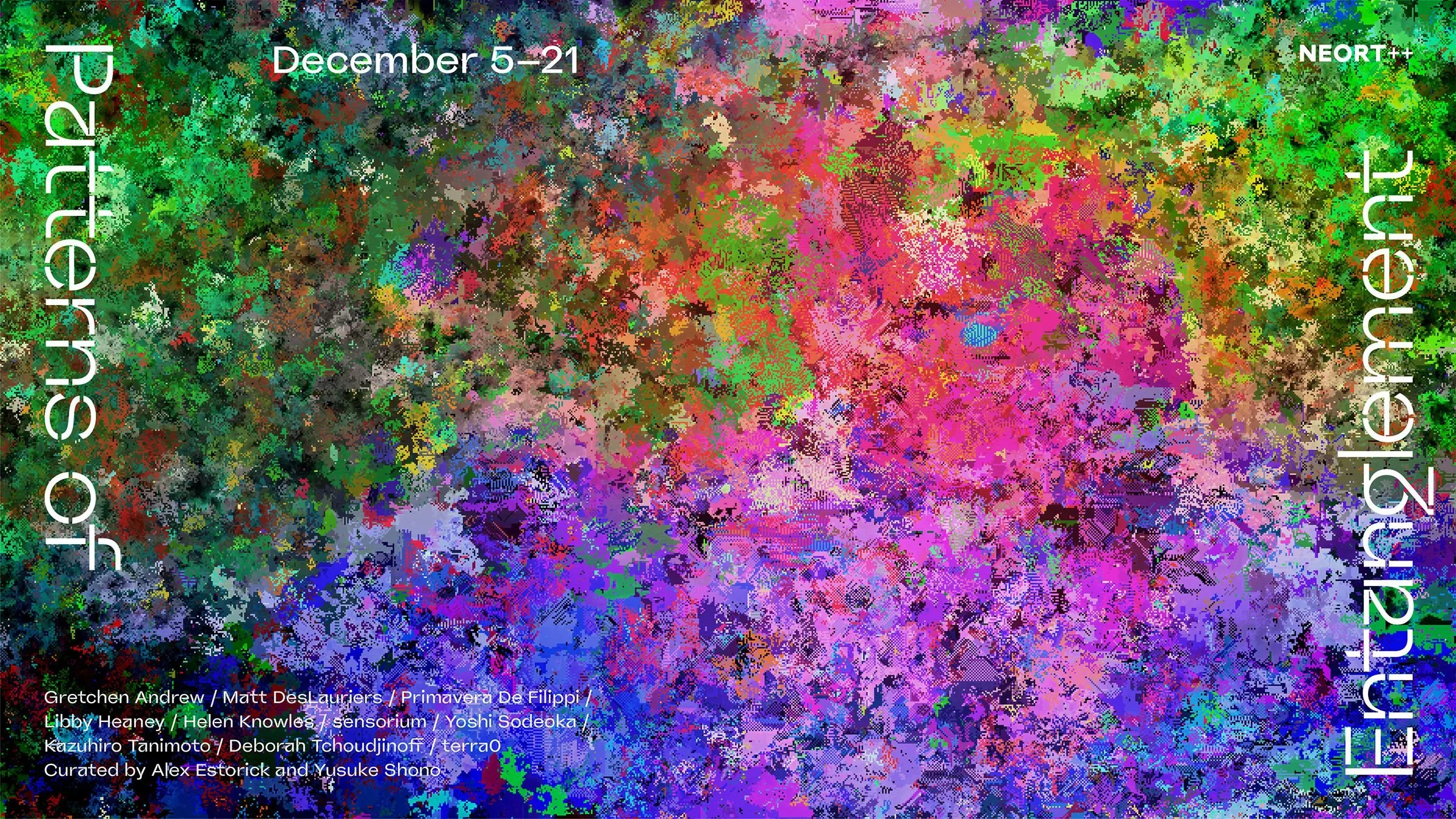
To end 2025, NEORT++ offers something rare in a year crowded with technological mythmaking and ecological dread: an exhibition that neither glorifies the machine nor idealizes the natural world, but instead treats both as co-produced, co-dependent, and equally unruly. Patterns of Entanglement, co-curated by Alex Estorick and Yusuke Shono, gathers ten artists whose practices ask what happens when we stop insisting on human exceptionalism and begin to trace the dense, often uncomfortable knots that bind us to everything else.
The shift is subtle but profound. Rather than approaching technology as the latest prosthetic for human will, the exhibition treats it as an evolving participant within larger ecological, economic, and political systems. And instead of framing nature as passive resource or nostalgic refuge, it recognizes non-human agencies as equally capable of shaping, absorbing, or resisting the world we share.
This is media ecology in its truest sense: not simply the study of media, but the recognition that everything: code, carbon, culture, soil, silicon — is continuously regenerating and transforming everything else.
Toward a More-Than-Human Image of the World
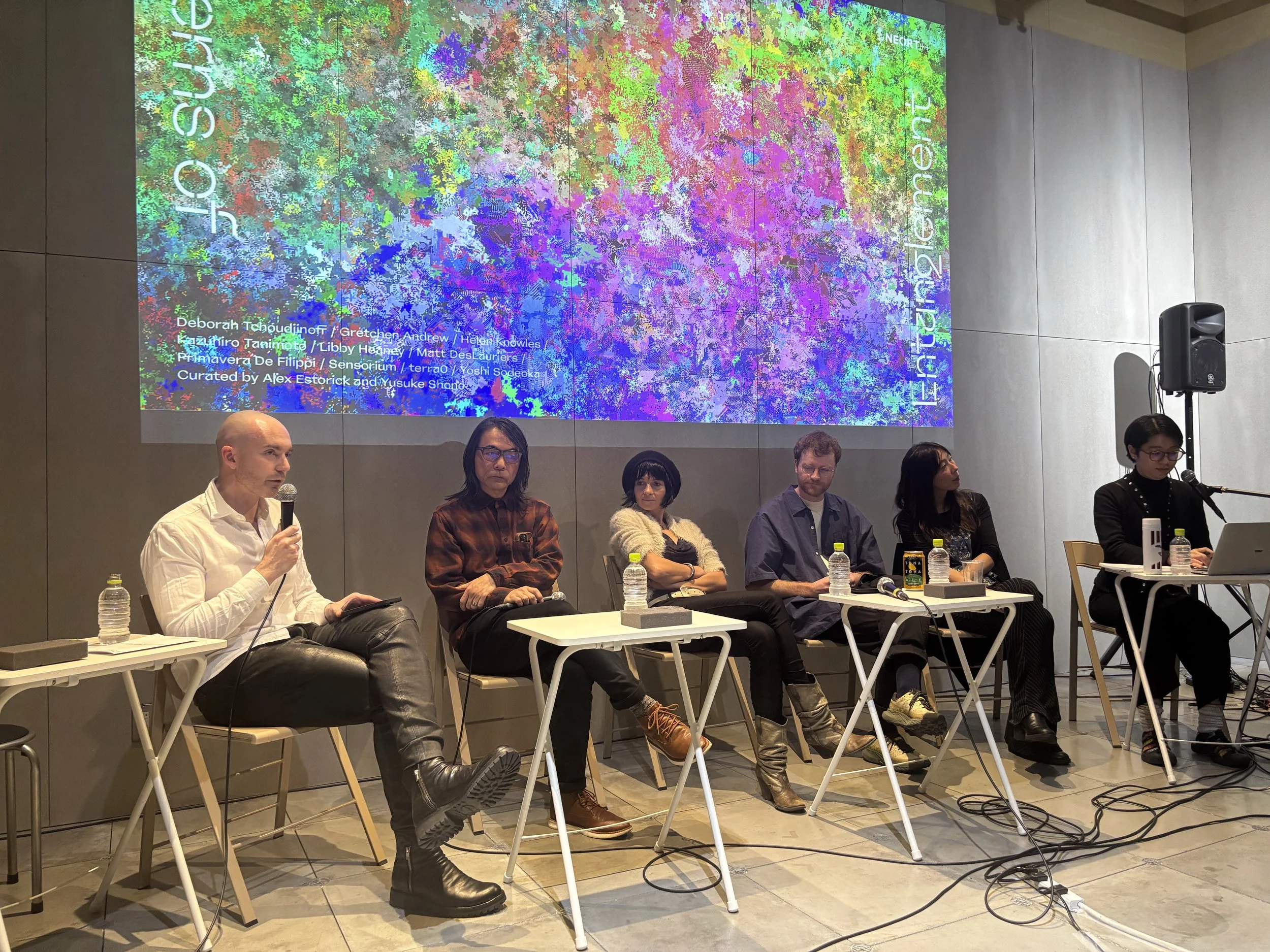
Entanglement requires maintenance; it produces obligations; it exposes conflict as well as connection. Crucially, it is not inherently benevolent. Colonial infrastructures, extractive industries, and platform capitalism are also forms of entanglement: proof that “interconnection” alone cannot save us.
This exhibition feels oriented by that realism. Across video, generative systems, quantum computation, algorithmic organisms, and participatory installations, the artists resist offering utopian communion or techno-salvation. Instead, they reveal how relationships—parasitic, commensal, amensal, mutual—continually shape our shared worlds.
Case Studies in Entangled Life
Libby Heaney — Qlimates
Heaney’s quantum-informed aesthetic is uniquely suited to an exhibition about porous boundaries. In Qlimates, she folds simulated imagery, AI-generated forms, and her own watercolour paintings into a narrative that refuses linearity. Monsters, hybrids, and oozing boundaries embody the instability of climate futures and the philosophical implications of quantum-scale interactions. The result is a work that feels alive, volatile, and insistently non-binary: a world where matter, image, and memory continually reconfigure one another.
Primavera De Filippi — Arborithms
De Filippi’s Arborithms continues her long-standing inquiry into blockchain-based lifeforms: organisms whose existence hinges on economic incentives and cryptographic structures. Here, evolution unfolds as a procedural and transactional system: trees inherit traits, reproduce through user interaction, and embody the logics of digital scarcity.
Within the context of Patterns of Entanglement, the work reads as a reflection on how technological infrastructures absorb our assumptions about value and agency. Rather than presenting blockchain as a utopian alternative, Arborithms subtly highlights the complexities —and limitations— of embedding life into systems shaped by human economies.
The piece sits lightly in the exhibition: conceptually clear, self-contained, and offering a counterpoint to more sensorial or immersive works without overstating its claims.
Matt DesLauriers — Latent Dispatch
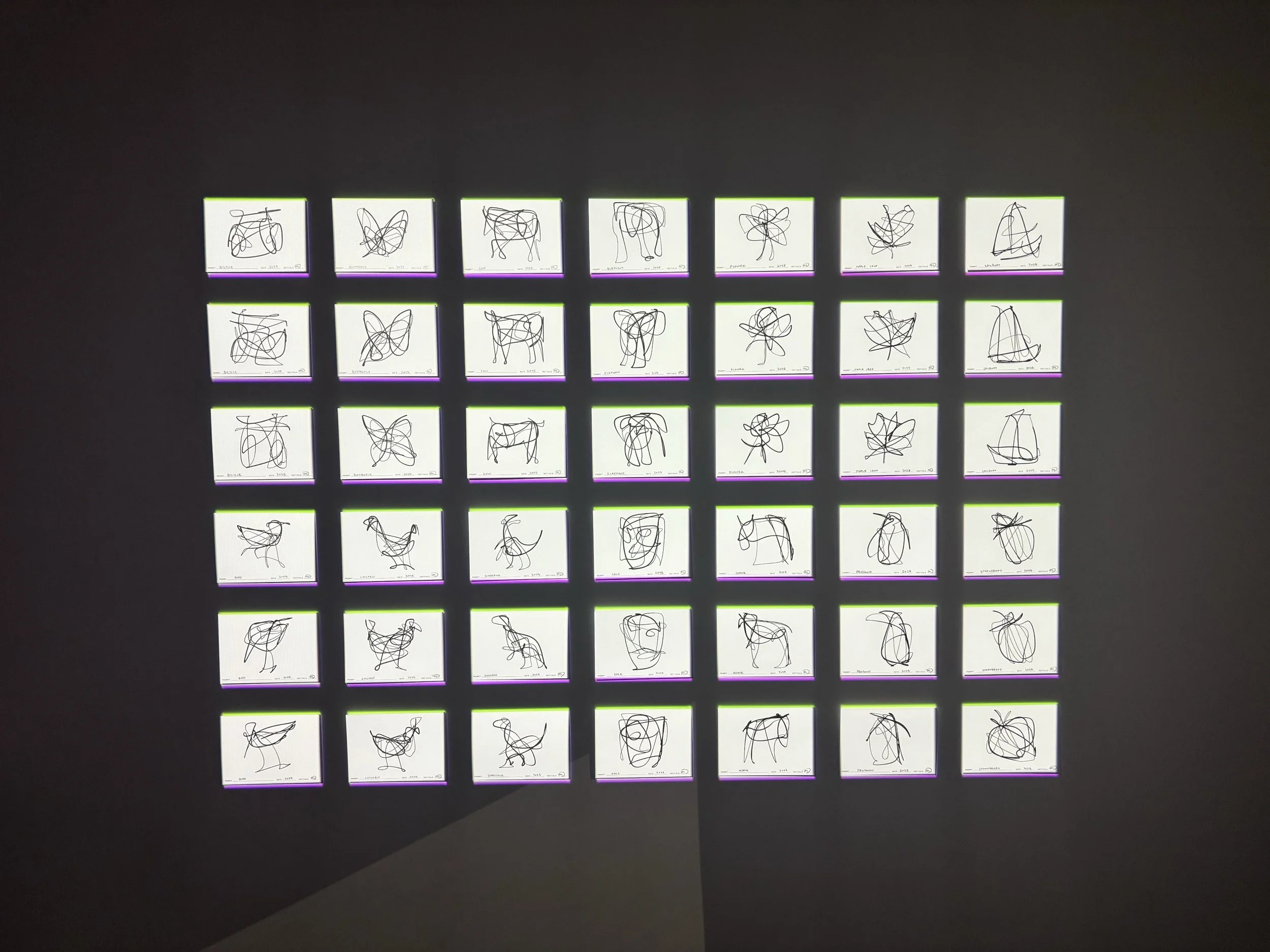
DesLauriers’ Latent Dispatch is one of the exhibition’s clearest arguments for why generative art still matters, not as a technical demo, but as a living conversation between systems and people. Rather than leaning on statistical “flattening” or the hyper-optimization of machine learning models, the work insists on deviation, gesture, and imperfection.
Plotter-drawn marks accumulate like responses in a long exchange: the machine offers a direction, the viewer disrupts it, the system adapts, and the loop continues. What emerges is less an image than an ecology of attention; a space where viewers become co-authors, and the machine acts not as oracle but as counterpart.
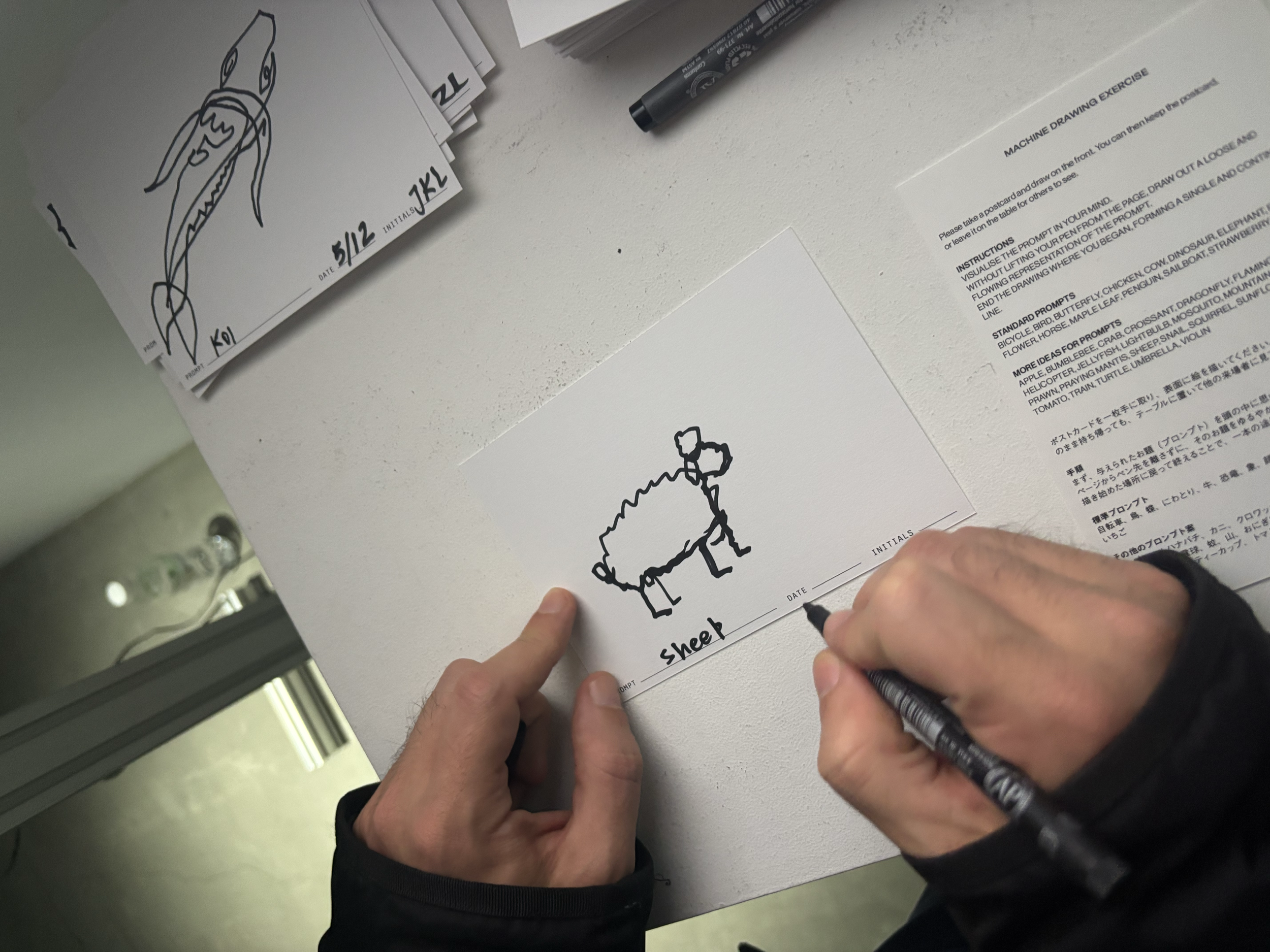
At a time when machine vision is increasingly designed to narrow possibility, Latent Dispatch quietly argues for the opposite: a world where variance is generative, interruptions are productive, and mutual influence remains the heart of creative practice. It is, in many ways, the exhibition’s most hopeful articulation of what “entanglement” could feel like.
Gretchen Andrew — Facetune Portraits: Universal Beauty
Andrew confronts algorithmic beauty standards by dragging their seamlessness into visibility. Her oil paintings, laboriously rendered from digitally “perfected” faces, expose the tension between desire, conformity, and the violence of homogenized aesthetics. The result is a double portrait: one of artificial beauty, and one of the collective, algorithmic pressure shaping it.
Helen Knowles — Indexed Beings & Trust the Medicine
Knowles’ expanded moving-image works investigate more-than-human intelligence and shared responsibility across bodies, systems, and institutions. Whether tracing Indigenous taxonomies of knowledge or reconstructing psychedelic visions alongside medical AI, her practice foregrounds relationality… not as abstract ethics but as situated, negotiated care.
Deborah Tchoudjinoff — The City of Gold / The City of Coal
Tchoudjinoff’s moving-image installation shifts the exhibition into geological time. Drawing on research into historical supercontinents, she traces how tectonic drift, collision, and separation produced the minerals that shape contemporary life.
From this emerges a speculative future: the supercontinent Amasia, in which new cities are named after the resources we now extract and exhaust. The City of Gold and The City of Coal, shown here for the first time in Tokyo, imagine worlds where value has outlived its material foundation.
The works do not stage catastrophe. They stage displacement: of meaning, of habitation, of human centrality. By situating culture within sedimentary time, Tchoudjinoff reminds us that our economies, technologies, and myths are temporary arrangements of moving matter.
terra0 — Autonomous Forest
terra0’s long-running inquiry into forest-as-agent appears here as a speculative governance model in which ecosystems exert economic autonomy. Their proposal feels both hopeful and cautionary: a future where forests own themselves, yet do so through the logics of property and markets. The tension is the point.
Kazuhiro Tanimoto — Mutual Field
A custom-developed cellular automaton blurs the boundary between artificial and natural systems. The screen behaves like an ecology: species proliferate, collide, and die according to rule sets influenced by environmental data. The system is not symbolic of the natural world, it behaves like one.
Yoshi Sodeoka — 21,000
Sodeoka translates decades of solar footage, diagrams, and hand-drawn notes into a multi-layered installation where natural cycles and computational gestures share equal weight. The work exists in a state of perpetual drift: a visual ecology built from sun paths, sketches, calculations, and improvisations.
sensorium — While you were… / Night and Day / Breathing Earth
These historically significant works remind us that artists were imagining planetary computation long before “real-time data visualization” became an industry. Their browser-based systems collect seismic activity, webcam feeds, births, deaths: not to overwhelm viewers with scale, but to embed them back into the planet’s temporal rhythms.
Ecologies, Not Interfaces
What makes Patterns of Entanglement compelling is its refusal to reduce complexity into metaphor. The show doesn’t say “nature is like code” or “technology is like a forest.” Instead, it insists that our world is already an ecology of both; and that every action, from scraping data to mining ore to making art, extends those entanglements.
If the exhibition offers hope, it is through mutualism: not the naïve belief that all things harmonize, but the recognition that all systems: digital, biological, political, evolve through relations that must be continually negotiated.
Art, here, is not a commentary but a collaborator.
A medium for sensing what else is possible.
Exhibition Information
NEORT++ — Patterns of Entanglement
5 December – 21 December 2025
maruka 3F, Nihonbashi Bakurocho, Tokyo
Wed–Sun, 14:00–19:00
Curated by Alex Estorick & Yusuke Shono
Installation by Arikawa Hiroyuki
Sound Installation by Takeyuki Hakozaki
Venue Support: CON_