

My two cents: Art Basel Miami Beach
There is a particular kind of déjà vu that settles in whenever the digital art world arrives at a traditional fair.
You will probably feel it in Miami this week: a sensation of standing at the fault line between two systems that do not quite know how to speak to one another, yet are increasingly required to.
The debate on CT has been very loud, as it always is: accusations of selling out, sweeping claims about institutional dilution, calls for rupture, celebrations of visibility, and laments about containment.
Many of these arguments touch on something real, but others rely on selective memory about who has benefited from legacy structures, and some rest on contradictions that speak more to unresolved tensions within Web3 than to the fair itself. It has become rather difficult to take seriously critiques that disparage institutions while depending on those same institutions for symbolic capital, curatorial validation, and sales. These contradictions are not personal failures; they are simply what happens when a movement transitions from outsider energy to institutional presence.
Some critiques present themselves as guardians of purity, yet they participate enthusiastically in the circuits of symbolic and economic capital they publicly denounce. This is not unusual in the art world.
As Pierre Bourdieu reminds us across many of his texts, moral authority is often constructed through the very structures it claims to resist. The point is not to shame this tension. The point is to understand it, because it reveals a deeper truth: Web3 is no longer a fringe experiment. It is a field negotiating its own legitimacy, and legitimacy always produces friction.
What is happening between Web3 and Art Basel is not a culture war. It is a negotiation of legibility.
And legibility, in Bourdieu’s terms, is never neutral. It sits at the intersection of symbolic capital, cultural capital, and institutional capital, three forms of power that appear separate but continually reinforce one another.
Artists create the work. Institutions create the frames through which that work is understood. Markets create the structures through which the work circulates. Curators operate at the hinge between these forces and are responsible for ensuring those structures do not suffocate the innovation they claim to welcome.
The real question is not whether Web3 should be inside the fair. The real question is how we build frameworks that allow the work to be understood, contextualized, and collected with rigor once it is there.

Mario Klingemann: Appropriate Response, 2025
The Myth of Selling Out and the Misunderstanding of Art Fairs
The accusation that showing at Basel is selling out misunderstands the history of artistic change.
The avant gardes were not anti-institutional romantics. They were actually deeply entangled with the systems of their time.
The Impressionists did not reject the Salon because they believed purity was a virtue, they built rival exhibitions because they wanted legitimacy.
Malevich did not present the Black Square in a vacuum. He installed it in the corner of the 0,10 exhibition, echoing the icon corner of Russian Orthodox homes and confronting the visual theology of his era.
The Futurists absorbed the promotional methods of emerging industries.
The Dadaists published in magazines funded by wealthy patrons.
The Pictures Generation appropriated advertising precisely because they understood its cultural force.
Every rupture has always been a negotiation with the structures it sought to transcend. Every art fair in history, from medieval merchant fairs to the Paris Salons to the Armory Show, has operated first as a marketplace and only secondarily as a cultural benchmark. To accuse Basel of being commercial is like accusing water of being wet.
If Web3 enters Basel, it is not capitulating. It is beginning the same process every movement has followed: becoming legible within the broader economy of art.

Visibility Is Not the Goal. Legibility Is.
What matters is not simply being in the room but being understood within it.
Visibility without context is spectacle.
Visibility without curation is flattening.
Visibility without proper placement is a missed opportunity.
Institutional recognition is not the problem. Misinterpretation is.
When institutions open their doors to digital art, two things happen at once:
Institutional capital extends recognition to digital practice. This matters. It always has.
Institutional formats pressure digital work to conform to established visual languages. This is the risk. Not presence, but misplacement.
This is why conversations about curation and sales are not side issues. They are central to the future of the medium.
Digital art does not lack innovation, it lacks infrastructure. It needs curators, advisors, CRITICAL (not hypocritical) writers, and sellers who understand both the medium and the marketplace.
The art is already strong. The ecosystem around it is still forming. We have taken such huge steps over the last few years, but we are still rather green.
The Real Work Now: Context, Placement, Stewardship
If Web3 wants to move beyond digital corners or digital sectors, it must cultivate not only artists but interpreters. The mediators who translate the work into institutional and economic language without diluting its identity. Web3 cannot scale without localized literacy…which, for the more finance/business oriented amongst us roughly translates to THINK GLOBALLY, ACT LOCALLY.
This is not selling out. It is building the architecture required for longevity.
Every movement that entered the canon developed:
Artists who advanced the form.
Curators who articulated its stakes.
Critics who wrote its history.
Advisors who cultivated collectors.
Institutions that conferred recognition.
Markets that developed placement strategies.
Communities that preserved what institutions neglected.
Web3 has the artists, it has the communities…what it lacks is a robust cultural and commercial mediation layer.
This is not failure. It is simply the next step.
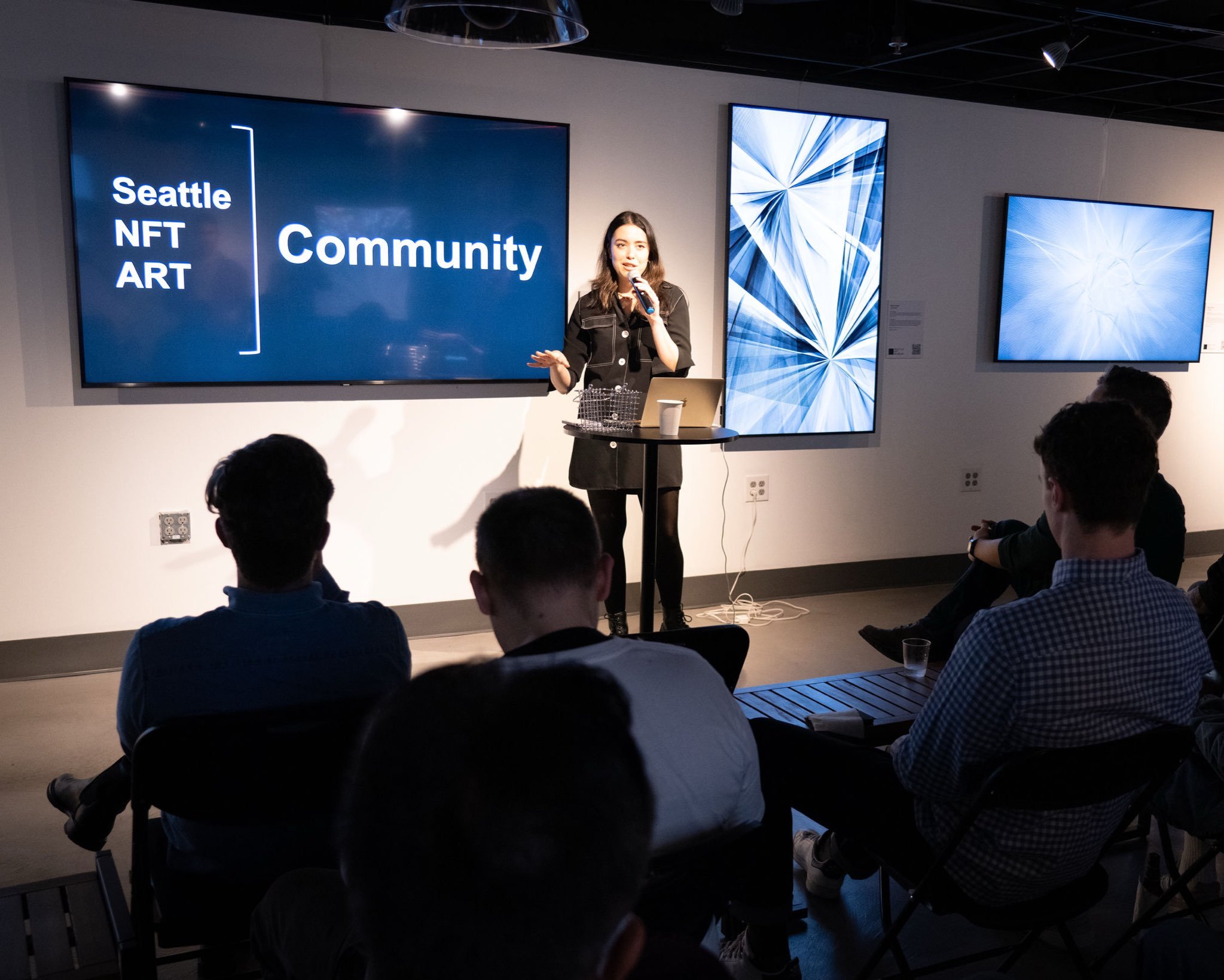
Throwback to my time curating the Seattle NFT Museum.
I’ve Said it Once, and I’ll Say it Again…Containment Is Not the Enemy.
Lack of context is. There is genuine concern about digital art being flattened or translated into formats that please traditional fair standards. But this challenge is solved not by rejecting institutions, but by participating with sophistication.
When digital work enters Basel, what matters is that it is:
contextualized correctly,
curated rigorously,
presented intentionally,
placed with collectors who understand its cultural and technical complexity.
Legitimacy does not come from rebellion or purity, it comes from context and placement.
Context is how a work enters history, placement is how it enters collections. Both matter.

We Are Not Diluting Web3?!?!?!!!!
Web3 does not fail by entering Basel, but it DEFINITELY would fail only if it decided that purity is more important than continuity.
There is no virtue in remaining outside the walls for the sake of optics… Movements survive because they learn to generate pressure, not distance, and to be completely blunt, purity narratives romanticize dispossession. Legitimacy narratives build continuity.
Web3 deserves continuity, doesn’t it?
Where We Go From Here
The debates of this week reveal that digital art has moved past the question of whether it belongs in the fair. It does.
The real question now is: who is doing the contextualization, and with what literacy?
The artists are producing excellent work, collectors are paying attention, and institutions are opening their doors.
The next step is ours:
Curators who understand the medium.
Advisors who know how to place the work.
Critics who can write with nuance.
Platforms that present with rigor.
Communities that hold accountability without hostility.
The work ahead is not fighting for entry. it is building the interpretive architecture that prevents the work from being misunderstood once inside.
This is not assimilation, this is maturation. And it reminds me of something my mother has told me since I was young: “quem cresce, amadurece,” which roughly translates to “those who grow, ripen.” The sweetest fruits do not toughen or turn bitter; they soften, deepen, and become more themselves, tastier.
The fair is not the enemy, misunderstanding is. And misunderstanding is solved through framing, literacy, and care.
How about we help build that?