

Digital Art’s Growing Pains: Platform limits, closures and context.

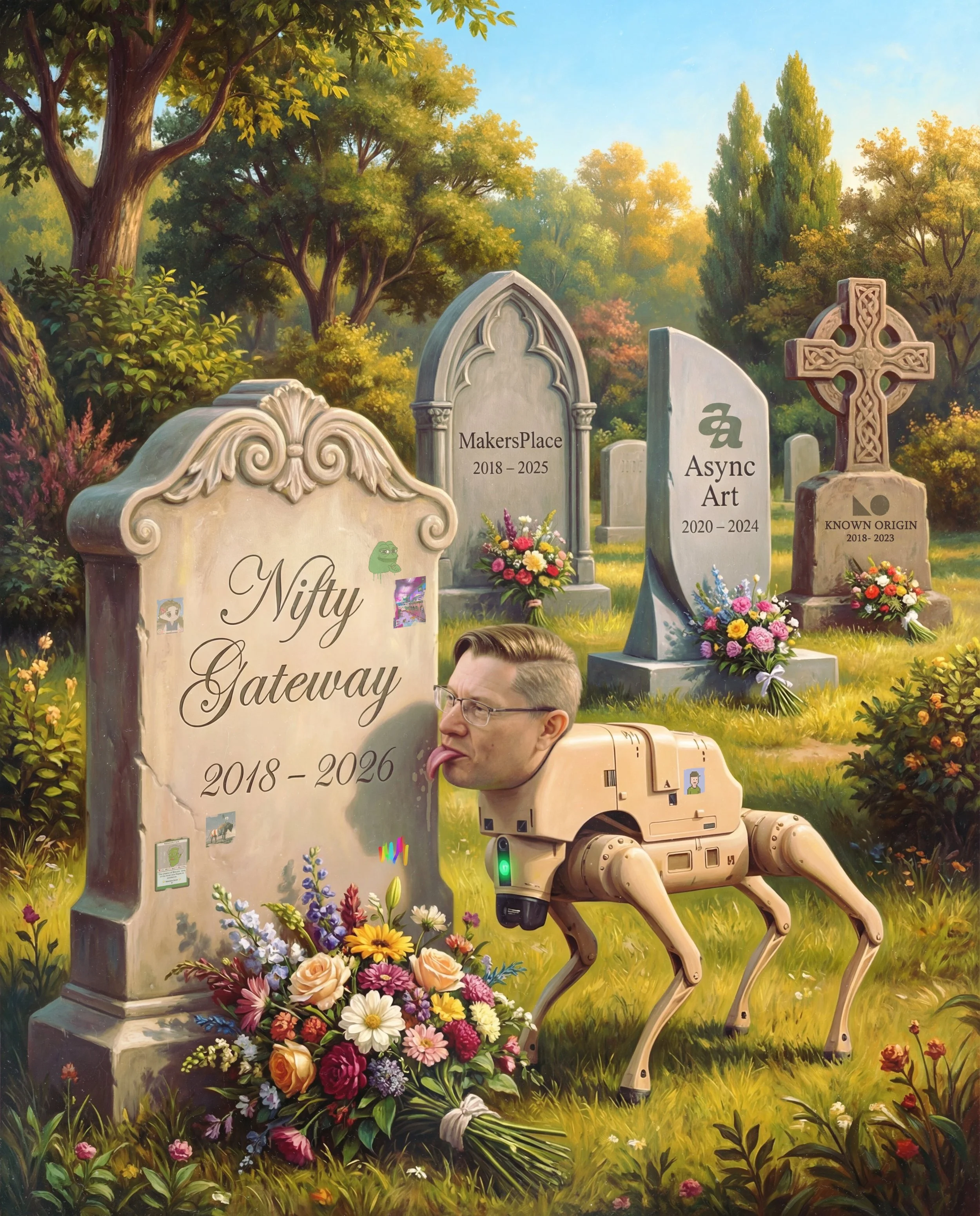
Platform closures can feel apocalyptic in a space that is still, by any measure, in its infancy. More often than not, they are framed as collapse.
In art history, they are more accurately read as transition. Salons tranform, change, close. Galleries dissolve. Journals end. What matters is not permanence, but what they enabled, and what they misunderstood.
Before commenting further, it’s important to acknowledge the ambition behind building a digital art platform at all. These are undertakings that require not only technical infrastructure, but cultural intuition, restraint, and an unusual tolerance for scrutiny.
My own experience in this space has spanned curation and content strategy across platforms like Art Blocks and Foundation. I worked behind the scenes, where the labor is largely invisible: the ongoing negotiation between artists, collectors, technical constraints, and public expectation. I saw firsthand what it takes to build, and to sustain, platforms under constant feedback, critique, and pressure.
Nifty Gateway, in this context, was never just a marketplace.
It functioned as a translation layer: mediating between crypto-native infrastructure and a broader public unfamiliar with wallets, gas, and custody. That role, often undervalued in hindsight, is worth recognizing before drawing conclusions about what its closure represents.
Where platform closures tend to be misread is in the assumption that something failed… More often than not, what we are witnessing is a lack of synergy and alignment with both artists, the artistic landscape, and market sentiment.

Digital art platforms by large inherited their operating logic from technology startups: optimize for scale, growth, and velocity.
These principles make sense for infrastructure. They make far less sense for art. This is another symptom of the over-financialization of the on-chain digital art market.
Art does not reward acceleration, if anything, resists it. Meaning accumulates slowly, through context, placement, and repetition across time. When platforms are designed around throughput: releases, metrics, weekly cycles, constant novelty…they inevitably begin treating artworks less as cultural objects and more as inventory.
This is not a moral critique. It is a structural one. A system built to move things quickly will struggle to care for things that require slowness.
When Art is Treated as Liquidity…
At the height of the NFT boom, liquidity became a proxy for legitimacy. Trading volume, floor prices, and secondary activity were frequently mistaken for indicators of cultural relevance.
But liquidity is a market feature, not a curatorial one.
In traditional art ecosystems, circulation is shaped by discretion rather than urgency. Works move when they are placed, not when they are pushed.
Reputation accrues through long-term synergetic alignment between artist, collector, and context, NOT (!!) through speed.
Many digital platforms collapsed this distinction. Artworks were launched, promoted, and discussed using the same cadence as consumer products. In that environment, curation often became indistinguishable from marketing.
Selection was framed as momentum.
Framing gave way to frequency.
The result was not bad artworks per se, but art without enough time to settle into meaning.
The problem was never legitimacy.
Digital art does not lack legitimacy. At least not anymore, and that question has already been answered by the work itself.
What the space often lacks is literacy, not aesthetic literacy, which is abundant, but the literacy of placement, history, pacing, and connoisseurship. The ability to situate a work within a lineage rather than a cycle. To understand not only what is novel, but what it is in conversation with.
Without this framework, platforms are left compensating with volume. And volume, over time, exhausts both artists and audiences.
When collectors step away, it is rarely because the work failed them. More often, it is because the surrounding behavior did.
our space lacks literacy
〰️
our space lacks literacy 〰️

What Platforms Got RIGHT
It would be disingenuous to discuss closures without acknowledging what platforms enabled.
Digital art platforms expanded access to collecting, both economically and culturally.
They introduced artists to audiences that traditional institutions would not have reached for years, if ever. They lowered the intimidation barrier and proved that curiosity, not pedigree, could be a point of entry.
They also created new forms of patronage, new collector identities, and new conversations around ownership and distribution. These contributions matter. They will continue to matter long after individual platforms disappear.
Closure does not erase impact. It simply marks the end of a particular configuration.

What Comes After the Marketplace
The question that follows every closure is deceptively simple: what replaces it?
This is the wrong question.
The future of digital art is unlikely to be dominated by fewer, larger marketplaces. If anything, it points toward fewer platforms and stronger contexts. Toward models that prioritize editorial clarity, curatorial responsibility, and slower circulation, supported by decentralized infrastructures that allow works to outlive the venues that once housed them.
Art does not require infinite venues. It requires appropriate ones.
This may mean platforms that look less like dashboards and more like archives. Less like launchpads and more like hosts…structures that understand their role not as engines of liquidity, but as custodians of meaning.
From Platform to Stewardship
In the long arc of art history, venues come and go: what persists are the relationships they facilitate and the standards they uphold.
If digital art is to mature within the broader canon, it must be supported by systems that value continuity over novelty, and care over conversion…that shift cannot be solved purely through tech. It is a curatorial responsibility.
Stewardship is quieter than hype, it rarely scales… but it is how art survives.
Reading Closure CLEARLY
The closure of a platform is not an obituary for digital art. It is a signal that an early configuration has run its course.
What remains is the work, as well as the responsibility to treat it with the seriousness it deserves.
Markets will continue to evolve. Infrastructure will continue to adapt. But art, as it always has, will outlast the systems built around it.
The question is not whether platforms close. It is whether, while they existed, we learned how to care for what they carried.
Building at this scale is never clean or linear. Nifty Gateway did so with ambition, and its impact will remain part of the record.